Welcome


Greetings!

Thanks for visiting my vintage Hamilton watch blog. I like to restore US-made Hamilton wrist watches back to their original glory and share my experiences with other enthusiasts. Use the "Search" space below if you know what model you're looking for. Feel free to leave polite comments or questions in the spaces provided. Also check out my "watches for sale" on my Etsy site - the link is on the right, just below.

Saturday, September 3, 2022

1955 Automatic K-402

 The "worst" watch I've ever come across was found on a beach on the Pacific coast.  All that was left was the dial and I could tell from the markers that it was from a Norman.

I recently came across a contender.  It also took a swim in the Pacific about 30 years ago.  The owner kept the watch but never had it addressed.  That is, until recently when he sent it to me to see if I could salvage it.

The model is a 1955 K-402.  It was made through 1957,


Looking at my project watch, there's a halo of rust around the crystal as well as on the dial.  To be honest, I wasn't really sure what I was going to find inside.


I was able to get the case back off and revealed the rustiest 661 movement I've ever seen.  The rotor was seized and there's really nothing inside that appears serviceable.  This is really a less for all watch owners - if you get water inside, especially salt water, make sure you get the watch dried and serviced as soon as possible.

The first trick will be to get the movement out of the case.


Success!  I was able to get the movement out and I was also able to get the dial off without breaking the dial feet off the dial.


The movement is held inside the case by a couple of case clamps.  I should be able to reuse them.


The inside of the case back makes identifying the model very easy - K402 is stamped right inside the back.


From this point I will have to proceed with a donor movement.  The crown on the rusty stem is from a Wittnauer watch so I'll replace that too.


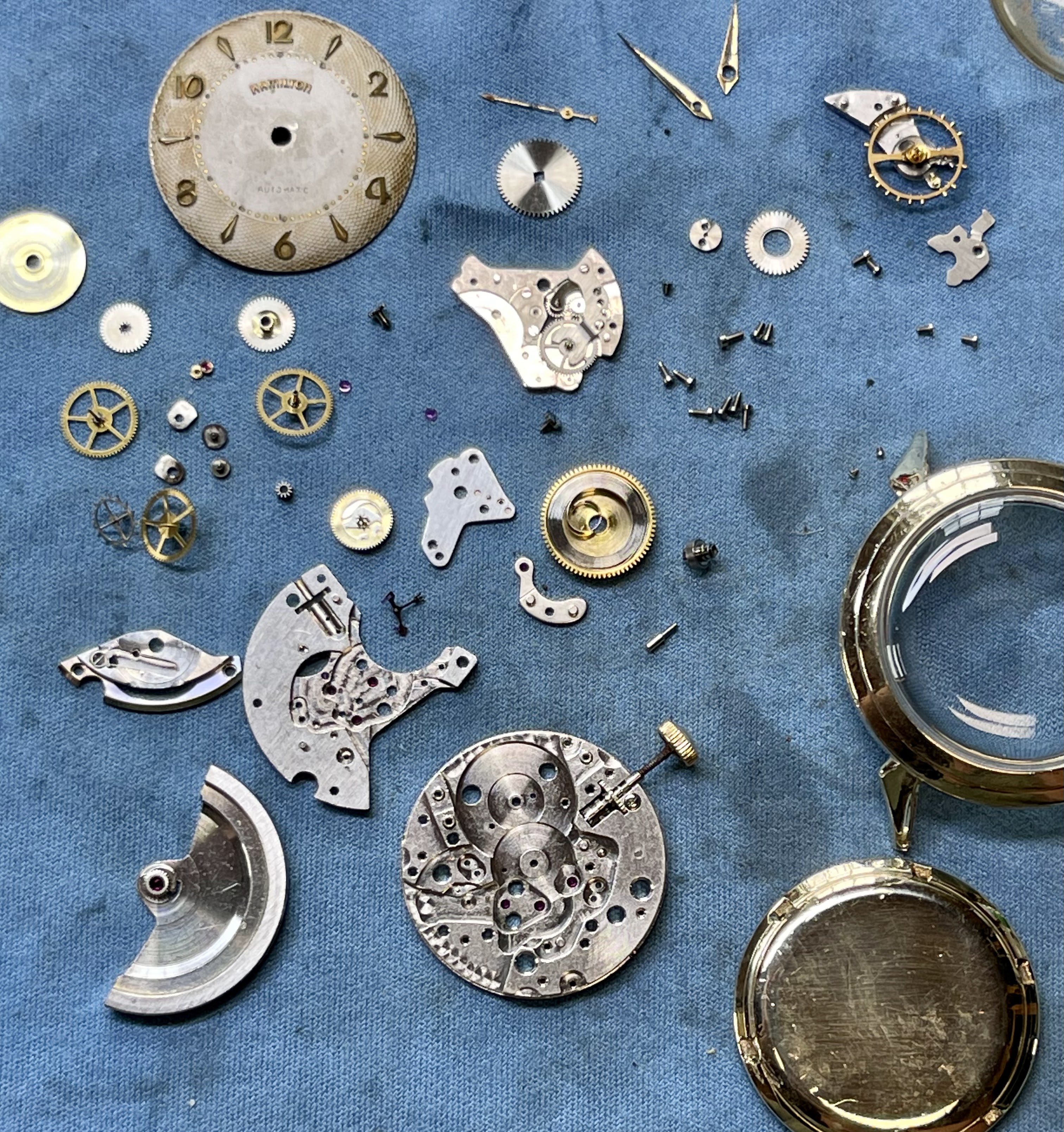
My donor 661 movement is completely disassembled, cleaned, and ready to be reassembled.  I was able to clean the dial fairly well but it's not perfect.  It will be a reminder to keep this watch away from the water in the future.

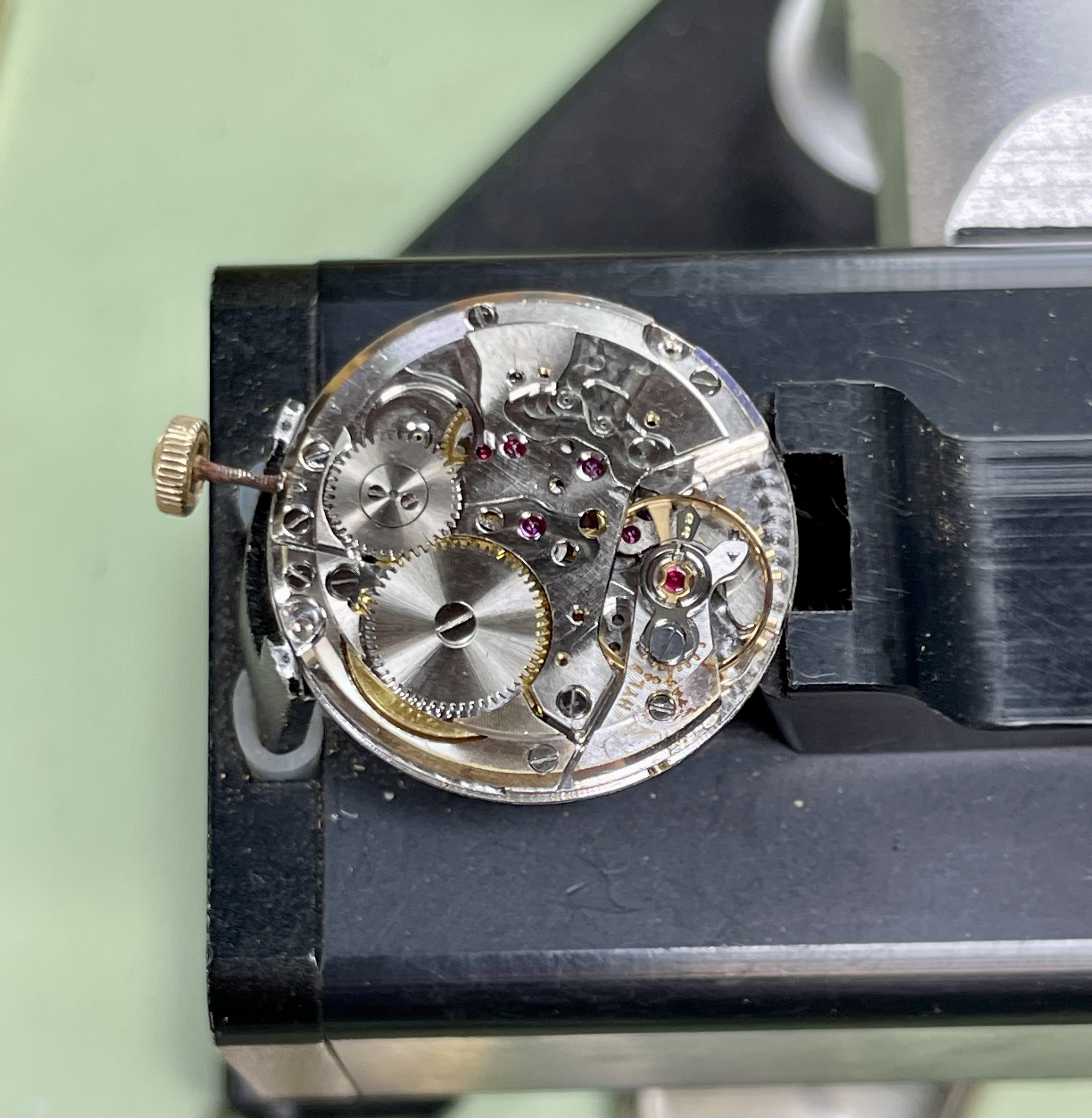
The reassembled movement is ticking away with good motion.  Now it's off to the timer to see how it sounds.

Not too shabby.  I will tweak the regulator and speed it up slightly.


A couple of very minor adjustments gets the beat rate running just slightly fast at 11 seconds fast per day.


The automatic framework and rotor are reattached and swinging freely - now it goes back into the case.


Well, I have to say that this watch turned out a lot better than I thought it was going to.  The dial cleaned up nicely and with the hands relumed along with a new crystal, it looks great, considering all that it's been through.


Monday, August 1, 2022

1901 940 Railroad

The Hamilton Watch Company got its start in 1892.  Pocket watches was its mission and especially watches certified to be used on railroads.  Overtime they would become the makes of "The Watch of Railroad Accuracy".  There is a surprising array of different models and many of the early examples are quite rare, after all, it was a new company and building a volume of inventory would take time.

Fast forward to 1901... nine short years later.  William McKinley was President of the United States until he was assassinated, and at 42, Teddy Roosevelt took over to became the youngest President in US history.

My project today was made at the same time and is a 21 jewel 18 size Hamilton 940 Railroad Watch.  The 940 is a great movement but it was really the entry level for railroad use.  There were several other higher quality movements made at that time.


A number of attributes separated the various calibers... number of adjustments, materials of construction, quality of nickel plating, you name it.  Some of the higher end calibers are too beautiful to hide behind a solid case.

The 940 is no slouch though and any Hamilton collector worth his salt probably should have a 940 in their collection - they are great timekeepers and fairly easy to find.

My project watch is well worn.  The case was warranted for 25 years which is a very heavy gold fill.  1901 pre-dates the jewelry standards of solid gold, gold fill, gold plate, etc. and instead cases were warranted against wear through for a period of time.  A 10 year case has less gold than a 20 year case, and that has less than a 25 year case.  A solid gold case might even say "permanent", as it would never wear through to a brass base.

My project watch case is very worn through - so this watch has a LOT of miles on it.  It arrived missing it's crystal.  Fortunately the hands are still present.  The enamel dial is a form of porcelain and it's not unusual for the enamel to show some cracks, especially near the dial feet locations.  This one doesn't look too bad... it's way better than I'll look when I reach 121 years old.

The case back is mostly brass... I think I can make out some sort of engraving but it has been lost to time.  The back and bezel thread on but they don't close all the way - hopefully that's just dirt and not a result of cross threading.  We'll see after it's all cleaned.

The movement tucked within is in nice shape.  It's nicely damascened.  Notice there is no caliber movement on the back.  It would be a few more years before Hamilton would add the caliber numbers to the engravings.  Based on the serial number this is a 940 movement.

With the dial and hands out of the way, you can see the workings of the lever action.  This is a lever set movement, meaning you have to slide the lever out to engage the parts needed to set the time.  With the lever pushed in, as shown, the watch is in the winding mode.  This way the watch can't accidentally pop into time setting mode - that was a railroad requirement.

With the barrel and train bridges removed, you can see the four wheels and pallet fork in their respective positions.  It's good to take a photo like this to remember which wheels go back in first.

Everything gets cleaned and dried.  The watch already has a white alloy spring inside so no need to change it.  Now it's time to put it back together with fresh oil in all the pivots.

The reassembled movement is noticeably brighter and shinier now.  It's ticking away with good motion.  Time to see what the timer thinks of it.

Originally when I saw the two lines so close together I thought, "Yes!  This is looking good." but then I saw the beat error of 9.0ms and realized the lines are actually really so far apart they are approaching each other from the wrong side.

Reducing the beat error requires removing the balance and adjusting the hairspring collet to better center the balance with the pallet fork.  It can take several attempts.

Getting warmer... down to 4.2ms.  I'd like to get it to as close to zero as possible but I'm usually okay with getting below 3.0ms.

Okay - down to 1.6ms... time to call it quits.  Now I can adjust the beat rate closer than 14 seconds fast per day.

Alright - pretty much right on the money now.

A new glass crystal completes the restoration of this great timepiece.  There's not much to do about the case so all I did was clean it in the ultrasonic.  Now the case back and bezel screw on nicely so it was just dirt holding things apart.

It's a nice looking movement.  Too bad I have to keep the cover on it.


Sunday, July 31, 2022

1932 Oakmont

 I recently posted about the 1969 Liberty Coin - a pretty rare model.  If you liked that post, you'll like this one too - it's a 1932 Oakmont.  The Oakmont was made for only three years and at the height of the Great Depression it's no surprise that Hamilton only produced 431 models in yellow gold.  They also produced models in white gold and you'll find quite a few used as sales awards for Packard automobiles, as well.


The Oakmont is part of the model line of premier wrist watches named after famous resorts / golf courses.  The line includes the Piping Rock, Coronado, Meadowbrook, among others.

In 1932 you could get the Oakmont in either a luminous dial or the applied gold numeral dial configuration.  The luminous version cost $75 and the AGN version required an additional $5 upcharge.  That's over $1600 in today's dollars.


My Oakmont project watch arrived in "some assembly required" condition.  The crystal was off (and chipped) the bezel was off, the back was off, and the hands were missing in action.  I had no idea what I was going to be in for.


The 979F was Hamilton's premier movement of the time.  It had 19 jewels, two more than the 987F used in other men's models.  The F stands for Friction, as the jewel setting (chatons) are pressed in place and held by friction instead of screws like the previously made 987 / 979 movements.  Other than that, they are identical calibers.  The 979 also featured a solid gold center wheel.

This movement looks okay.  However, the placement of the regulator at well-past fast is a little disconcerting.  Notice the male pins on the lugs - this model will require female spring bars to mount a strap.


Everything gets disassembled and throughly cleaned.  I'll put it back together carefully with fresh lubricants and then try to diagnose any issues I find... assuming there are any.


Well... it's ticking away with a good motion,  This looks promising.  I set the regulator to the midpoint to see where things land.


Hmmm... running about 4+ minutes slow.  That explains the position of the regulator.


There are two screws on the end of the balance arms that are for timing adjustments.  They are like the arms of a spinning figure skater... draw them in to spin faster and let them out to slow down.  You have adjust both the same amount though to maintain the poise of the balance.


Adjusting the balance is stressful and tedious work.  One false move and you will ruin the hairspring or break a balance pivot.  Each adjustment requires reassembly and placing the movement back on the timer to see how things look.


After four tries, countless drips of sweat on my forehead and all the salty language I learned in the Navy, I've got the balance looking good.  I made multiple tweaks on the timer and stopped when it was running just smidgeon fast with a great beat error.


Now to address the crystal.  I have a cushion shaped glass crystal but it's too large.  I can try to sand it down to shape but it will take a while.


My glass crystal didn't work out... I chipped it.  So plan B is to use a plastic crystal.


For the final step I had to open the strongbox, in the back of the safe, inside the vault, guarded by my two doberman's Zeus and Apollo, to get my stash of female spring bars.  Try finding some of these someday - you want to talk rare?


I put black spear hands on the finished watch.  That was pretty common back in the day but when I got the catalog snips for this post I realized that gold hands would be appropriate.  So I'll have to dig through my stash and find some.  Otherwise this watch looks fantastic and I'm sure its owner will be delighted with it.


There... I dug another set of hands out of my stash.  Now this watch is perfect.