Welcome


Greetings!

Thanks for visiting my vintage Hamilton watch blog. I like to restore US-made Hamilton wrist watches back to their original glory and share my experiences with other enthusiasts. Use the "Search" space below if you know what model you're looking for. Feel free to leave polite comments or questions in the spaces provided. Also check out my "watches for sale" on my Etsy site - the link is on the right, just below.

Saturday, December 12, 2015

1953 Robert

It's been a while since I've update my blog.  That's for a couple of reasons... first, I've been super busy with other stuff and second, I haven't had much luck finding watches that I haven't already posted about.

I guess after 450 models, it might get a little harder to post as often.  Don't worry though, there were over 1,000 different models made before 1969, so I have plenty more to find.  It's just going to get a little harder since I've done the most common ones already.

One of my recent finds is a 1953 Robert.  It was made for two years.


The Robert was part of a select group of models introduced in the 1950's that were paired with ladies models.  The Robert's mate was the Roberta and they make a great his & hers set.

The Robert and the Roberta each came in solid 14K gold cases and you'll find them in white or yellow gold.  They also came with black or a two tone silver butler finished dial.  So if you like to collect al variants, there are four different Roberts to choose from.

Tucked inside a Robert is a 19 jewel 12/0 sized 754 movement.  The 754 was used only in solid gold cases.  14K gold filled cased models would get the 19 jewel 753 and the 10K gold filled models received the 17 jewel 752.

Like most projects I receive, my Robert was in pretty rough shape.  It would tick though - so that was a good sign.


Without the beat up crystal in the way, you can see the dial is dirty but looks promising.  It might just clean up, you never know.


The movement has a frosted appearance.  That's a clear sign that it hasn't been cleaned in a long time.  Notice the color of the winding and ratchet wheels - they should be bright and shiny.


You have a 50:50 chance of being able to identify a 1950's watch using the case back.  Sometimes the model name is inside and sometimes it's not.  Sometimes it's even wrong... for example, the K-455 often says Transcontinental A inside.  But that's a different post.

You can see ROBERT is stamped inside this case back, along with the requisite Hamilton Watch Co Lancaster PA.  If you don't see Hamilton Watch Co (etc) inside the case back, it's likely not an original model... that's good to know when you're looking at platinum "top hat" models with 17 jewel 980 movement.

One thing you don't see inside this case back are any watchmaker's marks.  I wonder if this watch has ever been cleaned?


The dial-side of the main plate shows evidence of a little water getting inside.  That should clean up okay though.


I happened to have a decent dial that looks to be a good candidate if the cleaning process goes awry.  Actually, while writing this post I realized the seconds register isn't the same.  I think the dial in the baggie is maybe for a Gordon?


A new glass crystal will be a nice improvement over the beat up version that came with the watch.


Everything is cleaned, dried and ready to be reassembled with fresh lubricants.


The first thing to go back in is the mainspring, with a little grease to keep it well lubricated.


The reassembled watch is now running nicely.  After doing this for about 5 years I've started to get a sense for how well a watch is running just by looking at it.  Well, I can see if it's not running well, lets just say it that way.  This one is looking good but only the watch timer can really say for sure.


Running nicely, as I suspected.  Just a smidgen slow but that's easily corrected.


Out of curiosity I looked at the back of the dials too.  The one on the right is the correct model.  Notice the dial feet are in differently locations.  The one on the left is for a 14/0 sized movement like the 982.


The dial and hands go on and then everything is tucked safely back in the freshly polished case.  The new crystal and a nice croc strap complete the restoration.  The dial cleaned up pretty well - it's not perfect but it's better than my unforgiving camera lets on.  Definitely an improvement over what I started with - don't you think?


UPDATE:  Jan 19. 2016

Here's a photo of the same watch with a refinished dial.  I think it looks much better.  It's hard to get one of these two tone dials to be perfect as there is a lot going on with the two colors, various lines and hour markers.  This one looks pretty sharp though, note how the lines are evenly spaced around the markers.


Saturday, November 21, 2015

1968 Thinline 6503

By the end of the 1960's Hamilton had acquired the Buren watch company.  When production ended in Lancaster PA in 1969, Hamilton moved production to the old Buren facility in Switzerland.  Buren's presence in the lineup occurred long before that though - as most of the "thin" models use Buren manual wind movements or micro-rotor automatics.

The 1968 Thinline 6503 uses a manual winding movement, the Hamilton 639.


The Thinline series lives up to its name and as you would expect, they are very sleek watches.  I like them because the are really easy to put back together because the arbors on the wheels are so short.  The wheels just line themselves up, most of the time.

The 6503 follows the usual naming nomenclature.  The first digit 6 means it's in a 10K RGP case.  The second digit 5 means the back is stainless steel.  The 03 doesn't really mean anything other than perhaps it's the third model in the 65XX series.

Although the watch came on a specially selected bracelet or a strap, my project watch has a different bracelet.  It's K-Flex bracelet, which I'm not familiar with.  The watch and bracelet are in great shape overall but like all new-to-me watches, it gets a trip to the spa before it sees any wrist time.


The stainless steel back is deceiving.  You instincts might lead you to try to open it from the back but this is a front-loader and opens through the crystal.


The markers on the radial-finished dial are thick and bold.  The numerals are especially deep.  This dial looks new and near perfect to my eye.


The 639 is used in many of the Thinline models.  It's a well-made movement and fully jeweled.


Everything is cleaned and dried before being reassembled with fresh oil.  This movement actually gets four different lubricants in various places.


The running movement goes onto the timer to "see" how it's running.  The timer actually listens to the ticking though so in reality the watch goes onto the timer to hear how well it's running.


It's running pretty much right where I like to leave them after reassembly.  I find movements tend to slow down slightly after a little while.


It all goes back fairly easily although I had to replace the female side of the two-piece stem so the crown would stay put.  I think the bracelet looks pretty good so I reinstalled it.  I think Thinline 6503 is sharp looking watch.

Sunday, November 15, 2015

1936 Taylor

I think my favorite era of Hamilton watches is the 1930s.  Maybe it's the styling or maybe it's the pre-WWII innocence coupled with the Great Depression resilience of the American people, but there's something about the 1930's that is very appealing to me.  Watches were often bigger in the 1930's too, thanks to the 6/0 sized 987 series.

1935 ushered in the 14/0 sized watches too - and such a narrow movement allowed Hamilton to make long and narrow watches.  Eventually watches evolved into smaller designs and some of the 1940's models are downright tiny.

Anyway, one of the less common 14/0 models is the 1936 Taylor.  It was only produced for a single year.


The Taylor came in a 14 gold filled case in yellow only.  However, there are two different dial choices for the Taylor shown in the 1936 catalog.  Since the Taylor is gold filled, it received the 17 jewel 980 movement as the 19-jewel 982 was used solely for solid gold models in the 1930's.

I recently received a Taylor and it had all sorts of interesting things going on with it.  The main issue is it wasn't running but right off the bat you can see that it's an applied gold numeral dial.  It certainly seems to fit the bezel opening correctly and the seconds register is the correct shape too.  Is it a replacement or a non-catalogued option?  I suspect it shares the AGN dial with the 1937 Talbot, especially since both have an inlaid black enamel dial.  That's just an educated guess though.


The watch was also missing it's crystal so I'm lucky the hands and dial were still present and in good shape.  The lugs that hold the strap are moveable and appear to be solid, although there is a lot of play to them.


The 980 movement is correct for the watch and dates to 1936, just as it should.  It has one big problem though - the balance staff is broken as the balance wobbles easily.


Sure enough, the lower balance pivot is missing.  Hopefully the balance jewels are still in good shape.


The mainspring is set... that's usually the case in 9 out of 10 watches from this era.


A new white alloy Dynavar mainspring will add new life to this watch - assuming the balance can be fixed.


When it comes to a broken balance staff, you have two options... replace the balance staff or swap balances from another movement.  Swapping balances from another movement means sacrificing a movement, so replacing the staff is a better choice - or at least worth a shot.  I'll leave swapping balances as "plan B".

You need very specialized tools to change a balance staff and a nice staking set is one of them.


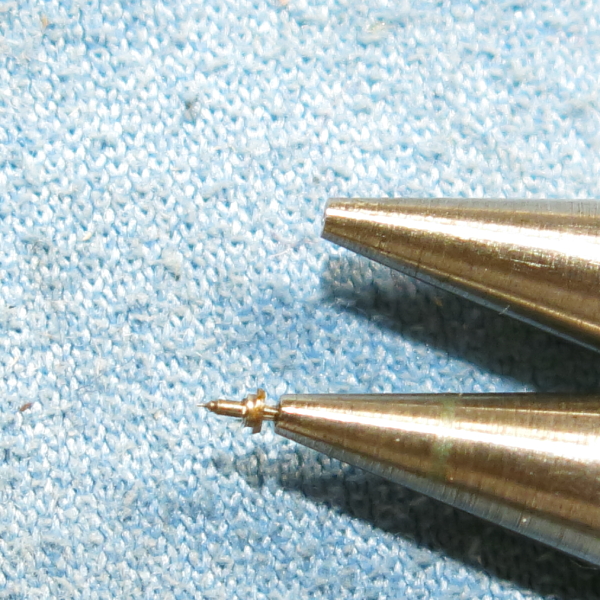
I'll need a new balance staff to replace the old one.


Many parts for one movement are reused in other movements and the 980's balance staff is also used in the ladies 911 grade, which is a 21/0 size, if I recall correctly.


The first order of business with changing a balance staff is to strip the balance of it's parts.  So the hairspring is the first thing off and then the roller table can be removed with the staking set and a specialized punch and stake.


This roller remover holds the roller table and then a punch pushes the staff down and out of the roller.  So balance drops down and the roller stays on top.


Now you can see that one side of the old staff still has a pivot while the other side is gone.


I'll position the old staff over the smallest hole that will accommodate the hub of the staff.


A special balance staff remover tool goes into the staking tool and a special punch will push the staff out of the arm of the balance wheel after a few light taps.


There... now I can get ready to install the new staff.


I can still get a little use out of the old staff though, I'll use it to select flat and rounded punches with holes that are just big enough to go over the staff.


I put the new staff in the smallest hole in the anvil that will support the staff.


Next, the balance wheel goes onto the little section of the staff that fills the hole in arm.


A few good whacks with the rounded punch will form a rivet on the staff and then some equally firm whacks with the flat punch will spread the rivet over the arm and tighten the wheel to the staff.


Now I can flip the balance over and reinstall the roller table, taking great care to align the impulse jewel with the marks I scratched into the wheel - so the roller is in the same place it was before I took it off.


The last thing to go on is the first thing I took off - the hairspring.  The hairspring looks to be in good shape but I don't like the angle of the hairspring stud... it looks a little off.


All of the other parts have been cleaned and are ready to be reassembled.


The moment of truth... the watch is now running so it's off to the timer.


Well that's not too bad... pretty good actually.  A little extra noise here and there so I'll reclean the hairspring.


Hey now, that even better, more amploitude!


What the?!!!  Flipping the movement over reveals it's not running very well at all when it's in the dial up position. The weight of the hairspring makes it hit the balance cock (I think) and makes the watch run faster.  It could be the angle of the stud has the hairspring out of plane... hairsprings require a bit of black magic sometimes.


Fussing with hairsprings can literally take hours to get right.  A tweak here makes another problem there and I have a low success rate with them.  On a rare movement that might be what it takes to get right but on a 980 I don't think the juice is worth the squeeze... it's time for Plan B.

Ah... a replacement balance from a donor 982M is running nicely.  The beat error is under 3ms and within my personal specs.


Flopping the movement to 12 up and the dial up shows little to no change in the performance.  This movement is ready for wrist time again.


A new glass crystal will complete the restoration and protect the dial and hands from damage.


A new genuine croc strap adds a final finishing touch to this Taylor.  The case shows a hint of wear through to the high points but I think it looks fantastic considering what I started with.