Welcome


Greetings!

Thanks for visiting my vintage Hamilton watch blog. I like to restore US-made Hamilton wrist watches back to their original glory and share my experiences with other enthusiasts. Use the "Search" space below if you know what model you're looking for. Feel free to leave polite comments or questions in the spaces provided. Also check out my "watches for sale" on my Etsy site - the link is on the right, just below.

Saturday, September 13, 2014

1958 Lowell

One of the mysteries to me about Hamilton is how they decided to name their models.   Pocket watches and wrist watches usually received names.  Men's models got mens names and ladies watches got ladies names - although there are exceptions to the rule like automatics and watches named for other reasons... like places.  Despite the fact that some obvious names were never used... like Joseph or David, there are a number of repeat uses of the same name.

Take for example, the 1958 Lowell.  There was an earlier Lowell from 1935.   I guess 20+ years was enough time to eliminate any confusion between to models and the latter Lowell has nothing in common with the earlier version.

The 1958 Lowell was produced for four years.

The watch comes in a 10K RGP case with a stainless steel back.  The white embossed dial with golden markers covers a Swiss-made Hamilton 673 movement - AKA an A. Schild AS 1200.

I recently picked up a Lowell in need of some love.  It wasn't running and it wasn't setting properly but my main concern was the brownish tone around the outside of the dial perimeter - that's a good indication that moisture got inside and compromised the dial finish.  The case is very nice though - so this watch is definitely worth saving.


The stainless steel back is engraved with three initials and the date 6-10-59.


Without the beat up crystal in the way, you can see the finish on the dial is crackled.  I could try my poor man's refinish if I can lighten the toning a little - otherwise I'll need to send this dial out to be refinished.


The 673 movement is in decent shape.  It's not obvious at this point what is preventing the watch from running.  A gentle assessment of the balance indicates the balance staff is in good shape.  I'm confident a thorough cleaning will do the trick.


As soon as the dial was removed I discovered the reason for the setting issue, the set bridge, AKA set yoke, is broken.  This little spring loaded arm covers the setting wheels and also acts like a detent to hold the set lever in either the winding position or the time-setting position.


Reassembling the now-clean movement brings it back to life.  It's running with good energy and a decent beat error too.


Well, it took about 2 seconds for the brown tone on the dial to disappear but it took most of the minute track with it.   My poor mans refinish won't work without the printing on the dial.  So I'll send this dial out to be redone.  It's a not a terribly complicated pattern - so it should come back okay, I bet.


Come back in a few weeks to see how it turns out.

In the mean time, checkout how this 1938 Gilman from last month turned out.

UPDATE: November 6, 2014:

Well, my refinished dial finally came back from the refinishers and they did a nice job matching the lettering and minute track.  I'd much rather have a nice, complete original finish but a good refinish is an improvement over what I was left with above.


Wednesday, September 10, 2014

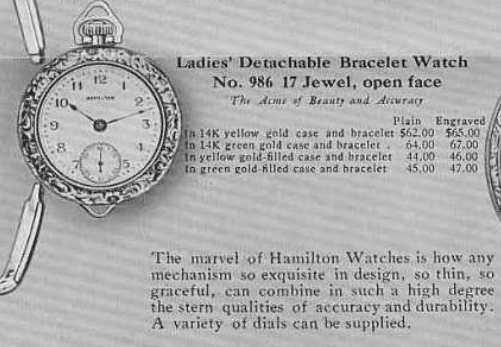
1916 Ladies 986 Bracelet Watch - Overhaul

Hamilton's very first wrist watches were ladies pendant watches, starting in about 1915.  Wrist watches were considered very feminine.  Real men used pocket watches.

Of course, the "Great War" proved that plenty of real men demonstrated wrist watches had their merits and by 1919 men's wrist watch models with larger 0-size movements were also available.

Anyway, Hamilton was primarily a pocket watch company until the introduction of the 6/0 sized 986 movement.


The 986 Bracelet watch came in both solid or filled gold, in green or yellow, in engraved or plain.  You could wear it as a pendant from either end, or you could wear it on your wrist.

It was introduced in 1915 and continued to be produced until 1923, when the movement was replaced  by the 986A and ribbon-style straps were introduced.

I've worked on a number of 986 movements because they were also used in men's models - especially during WWII.  Hamilton's production was dedicated to the war effort but they were able to produce watches for civilian use by utilizing excess inventory of 986 and 986A movements.  These WWII Cushions, as they are known, are easily identified by their 10K gold filled case.  I like the 986 movements because they put the second hand at the 9 position - very unusual and very cool.


I recently received a 986 Bracelet watch from a fellow collector, along with a couple of other watches in need of help.  It dates to 1916, so pretty early for the grade.  Since I haven't detailed this particular movement, I thought I'd show a step-by-step (for the most part) approach to an overhaul.

As received, the watch was running but a bit noisy on the timer.  It was definitely due for an overhaul.  The model comes in a three-piece case, with a front, a back and a center section that holds the movement.


The back is unengraved and in good shape.  However, the lip to open the case back is very worn so it took some doing to pry it open.


The 986 is a pretty movement.  It's nicely damascened and the train bridge is ornately detailed.  Other than the missing train bridge screw, it looks fairly familiar to later movements but this one threw me a curve ball... where's the set lever screw?


Well, it turns out the 986 came in two setups... a negative-set movement (like most pocket watches of the day) where the stem is integral to the case, and a positive-set movement where the stem is retained in the movement by a set lever.  I had only ever seen the latter setup.

Once I removed the two case screws and pulled the crown out to the set position, I could push the movement out the front.  In the shot below you can see the stem is still in the case - just like a larger pocket watch.  This was the first time I encountered that with a 986 movement.


With the dial and hands out of the way, you can see there is a series of springs in the negative-set movement that will keep the keyless works in the time setting position.  When the stem in the case is pushed in (and held in place by the sleeve in the case) the springs are overcome and the keyless works move to the winding position.


Compare the shot above to the shot below of the positive-set version of the 986 movement.  Notice how the set lever and set lever spring hold the movement in the winding position.  When you pull the crown out, the set lever pushes the spring and slides the clutch over to the time setting position.

Interesting, huh?


With the cannon pinion and hour wheel removed from the front, I'll flip the movement over and (with the mainspring relieved) I can start to disassemble the back, starting with the ratchet wheel and smaller winding wheel to the left of it.


Now I can remove the screws that hold the barrel bridge in place and expose the mainspring barrel and center wheel below.


The center wheel is partially blocked by the train bridge - that's good to note for reassembly so I put the center wheel back in before the train bridge.  Only two of the three screws are present for the train bridge - that comes out next.


With all the wheels out of the way, as well as the keyless works, the balance assembly is next to come out.  The 986 has a single-roller balance and that means it's even more delicate than usual - so great care has to be taken at this point not to goof this part up.


Once the balance is gone, the only key part left to go is the pallet fork and it's bridge.


Before I put the parts in the cleaner, I'll check the mainspring... sure enough, it's set.  The 986 doesn't run as long as a 987 to begin with, so a fresh mainspring is definitely a good idea.


I happen to have a small stash of springs.  The key with original springs like this is that they cannot have ANY rust whatsoever.  If there's any rust, they will break but if they are rust free, you can probably still use them.


My new mainspring will definitely have a lot more life and runtime than the old spring.


While everything is being cleaned, I'll also take the time to replace the yellowed and scratched plastic crystal with a new glass replacement.


Everything is cleaned and ready to be put back together.


The movement is running again - yay!  One of the things I HATE about the 986 is one of the case screws is dangerously close to the balance assembly... see the open hole right next to the balance?   After you get to this point, there's is nothing more discouraging than slipping the screwdriver off the case screw and jamming it into the hairspring or, worse yet, breaking the balance staff.   Been there, done that.


It's running a little slow, decent amplitude but YIKES - look at that beat error!  9.2ms is terrible.  You absolutely need a timer like this if you are going to work on watches.  I checked the position of the impulse jewel relative to the pallet fork and I thought it looked good.  This was an unpleasant surprise.


One thing I did not do is demagnetize the movement.  So I passed it through my demag unit before attempting to take the balance off.  Check out this difference.  Much better amplitude and a beat error to be proud of.


A little tweaking to the regulator brings the beat rate up a little and into the "excellent" range.


Everything goes back into the case and I have to say, this little watch turned out really well!  The bracelet is obviously not original but the watch will now run 30-36 hours on a full wind and keep excellent time.  Not bad for being almost 100 years old!


I did notice that the minute and hour hands were not moving while the second hand did - that's a sure sign of a loose cannon pinion.  So I had to take the dial off one more time to tighten the cannon pinion on my staking set - but now the watch is "perfect".

Sunday, September 7, 2014

1961 Automatic K-418

There were a number of "one-year wonders" introduced in the 1960's, or watches that were only produced for a single year.  I sometimes wonder if Hamilton was pulling out all the stops and putting anything that would tick on the market or if their marketing folks were so in tuned with what customers wanted that they killed things that didn't sell well.  Maybe it was a little of both?

Another theory is a shift in their supply base as they moved away from 1950's era Swiss watch movements and into 1960's grades from different makers.  The 1960's designs allowed for thinner watches, which may have been more fashionable.  That's probably a more plausible theory.

A good example is the 1961 Automatic K-418.  It was only produced in 1961 and it was one of the last years to use the Kurth Freres 667 movement.  Most of the automatics in the 1960's were micro-rotors from Buren or ETA-based grades.


The K-418 has a 10K gold filled case, as you would assume since it's a 400 series watch.  The embossed dial is unique because it has a golden ring on the outside perimeter as well as a field of raised rings in the center.  The watch features luminous hands and dots outside the hour markers.

Tucked inside the case is a Hamilton 667 movement.  This movement looks a lot like the 661 that was very prevalent in the earlier automatic models.

The 667 is the grade found in one of the most rare Automatics... the Pacermatic, which is an electric Pacer case with an automatic inside.  If you ever come across a Pacermatic, make sure it's not a fake. The best way to tell is the serial number of the case.  Pacermatics have case serial numbers in the 528500-528800 range and 637700-638200 range so there were only 800 total made.

My project K-418 arrived in relatively good order.  The lugs have a little wear to the inside thanks to a metal bracelet.  The crown is worn smooth - it's so small that I doubt it's original, but maybe.


It's a little hard to read, but the back is engraved with a name and the date "1964".  That's interesting, since the watch was produced three years earlier.


The 667 inside appears to be in good order but I'm sure it will benefit from a trip to the spa.


As you can see, there are a lot of parts to these watches.  There are a variety of different screws too and I think it's interesting how often I find the wrong screw in the wrong place.  You can see I spilled a little of my luminous powder on the cloth as I relumed the hands when everything was in the ultrasonic.


One of the tricky parts to reassembling this style of movement is to get the train bridge on.  Three wheels have to be lined up at once... the 4th wheel in the center, the 3rd wheel to the below right and the silver escape wheel just to the left.  Some of the nickel plating on the main plate has been lost to time.


In the shot below, this is the angle that I have to look in order to tweak the wheels and get their respective pivots into each corresponding jewel in the train bridge.  The bridge will fall into place when everything is lined up.  If it's line up correctly, when I spin the center wheel, all four wheels will whirl around.


After the train bridge is on, I can put on pallet fork (left) and the barrel bridge along with the winding wheel and ratchet wheels (right).


Next to go back on is the balance assembly.  With a few turns to the mainspring, the watch will start running if the balance is in the right place.


The now-running movement goes onto the timer.  Nothing too shabby about this watch.  The amplitude of 183 is a little low, but I didn't fully wind the watch yet.


Now that the watch is running, I can put on the rest of the parts that are needed for the automatic mechanism, there's a rotor carrier as well as a clutch wheel.  The clutch is just below the winding wheel in the shot below.  It enables the watch to wind in only one direction, but allows the rotor to move in either direction.


The rotor carrier can be a bugger to get back on.  There are three moveable connection points that have to be properly aligned for the carrier to seat.  It takes a little finesse to get all three lined up at the same time.


The crown needs to be replaced but the stem is pretty rusty too.  It's not terrible, but I'll replace it with a new one when I install a new crown.


The dial and hands go back on and the movement goes back in to the case.  The new stem is too long  and will need to be trimmed to just the right length.


The best way to hold a stem for trimming is with a pin vice.  I have found that when trimming stems it's best to leave them a little long and slowly work your way to the perfect length.  Too short means you have to start over.


Success.


With the movement running and back in the case, the last thing to go back on is the rotor, aka, the oscillating weight.  As this part swings around on the red jewel, it winds the watch.


The rotor drops in place and is held in place by the little toggle switch above the arrow.


A new crystal and strap complete the overhaul.  The finish on the dial is a little lighter on the right side - I suspect that's the effect of moisture coming through the stem.  It's not obvious though.  I wonder if cleaning the dial would make it look more even but this is a classic "know when to stop" situation.  I could just as easily ruin this dial by cleaning it any further.  It's not perfect, but it's 50+ years old, so not being perfect is okay.