Up until the late 1920s Hamilton was known for pocket watches and especially railroad-approved pocket watches. What exactly defines the standards for "railroad-approved" depends... it changed over time and it also was dependent on what railroad you were talking about. Some regional lines had less stringent requirements than larger lines. The need for standards was literally of life and death importance. Often trains going in opposing direction had to share the same track. They had to keep to their schedule or they could hit each other straight on. A few cataclysmic collisions created a nation-wide shared need for time pieces that varied by no more than 30 seconds over a full week.
Generally speaking, railroad approved watches had to meet the following requirements:
- American-made 18 or 16 size
- Open faced
- Configured with the winding stem at 12 o'clock
- Fitted with 17 or more jewels (later changed to 21 jewels on most lines)
- Temperature and isochronism compensated
- Adjusted to 5 positions
- Lever Set
- Double roller
- Micrometric regulator adjustment
- Steel escape wheel
- Plain while dial with black Arabic numerals and each minute delineated
- Certified to +/- 30 sec/week
Looking at the above, a lot of very nice watches would not be railroad-approved. For example, any watch that is Hunter-cased, or that has a cover over the dial. Also, any watch that is considered a "side-winder" with the pendant positioned at the 3:00 position would not be considered a railroad watch. The watch has to be lever set, so if a watch is pendant set is wouldn't meet the standards, regardless of time-keeping ability.
I recently picked up a very nice project watch that I haven't shown on the blog before. It's a 19 jewel, 16 size No. 996. Is it a railroad grade? Arguably yes and potentially no. The 996 was introduced in 1915 and produced through about 1927.
The 16-size 992 is arguably what Hamilton had in mind for a 16-size railroad watch. The larger 18-size 940 was a great working-man's railroad watch as well, but the smaller 16 size was viewed as preferable once they were introduced.
Comparing the 992 to the 996, you can see they are very similar. The two main differences are the the jewel count and the type of barrel design.
Not everyone would agree that my project watch was railroad-approved but the one thing everyone would agree on is that it's a "train wreck". In fact, one reason why I thought this would be a good project for the blog was it's full of teachable moments for new collectors.
As received the watch has a yellowed plastic crystal. This type of material is actually a very old type of plastic that turned yellow as it aged and outgassed a chemical that rusted the hands below it.
The case is in very good shape. There isn't a lot of wear but there are a couple of minor dents on the back.
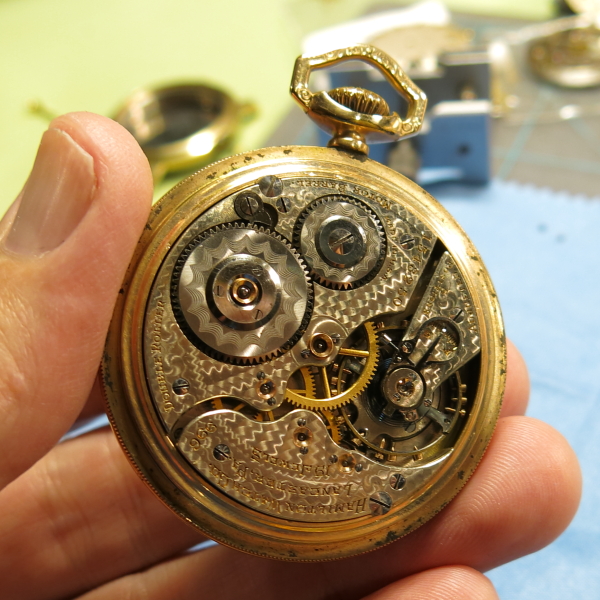
One of the reasons this watch attracted my eye is it's beautifully crafted. Check out the detailed damascening. Motor barrels are supported on both sides by jeweled settings - and that's what brings this otherwise 17 jewel movement up to a 19 jeweled grade. The 21 jewel 992 doesn't have a motor barrel. It's extra 4 jewels come from additional cap jewels that cover the escape wheel and pallet fork. However the 23 jewel 950 does have a motor barrel.
With the bezel removed you can see the hands are a rusty mess and will need to be replaced. You can also see the lever for setting the watch. It's positioned at about the 6 minute mark.
As I had hoped, the rust was limited to the hands and the very tip of the cannon pinion. The rest of the movement is in very good condition.
This movement is not in operable condition. The balance wobbles so I know the balance staff is broken. It also winds and winds and winds - a clear indicator the mainspring is probably broken.
The motor barrel design is a unique feature and in this watch the arbor for the mainspring has several parts. In order to separate the ratchet wheel from the arbor I need to use a wide screwdriver to remove a cover that threads into the arbor below - sandwiching the ratchet wheel in between.
Once the cover is unscrewed, you can see the pentagon-shaped joint between the arbor and the ratchet wheel.
Here's a shot of the three parts... the cover at the top, the arbor on the right and the ratchet wheel. The cover threads into the arbor.
The arbor engages the inner coil of the mainspring and you can see in the shot below that the mainspring is broken.
Piece by piece the movement is disassembled.
Before I remove the balance I will free the hairspring stud. That way I can take the balance assembly off the balance cock. You can see the blue hairspring stud is typically held in place by a cover with two screws. You remove one screw and rotate the cover to free the stud.
Both pivots of the balance staff are missing... either worn down by a lack of lubrication or broken off by dropping the watch on a hard surface.
The last thing to come off is the pallet fork, held in place by it's bridge and two screws.
As Robert Burns said, "The best-laid plans of mice and men often go awry" and my plan to use the 974's balance has one big flaw. The 974 does not have a double roller. That's another railroad requirement, by the way.
Looking at the photo below, notice the 996 balance has a small circular ring on the roller table. That ring helps prevent the balance from over-banking if the movement is jostled. When a watch is over banked, it means the balance's impulse jewel falls onto the wrong side of the pallet fork. To visualize the problem, form your left hand into the shape of a peace sign. Using your right index finger as the makeshift impulse jewel, it should fall in the "V" of the two-fingered peace sign of your left hand. When a watch over banks, the pallet fork moves and the impulse jewel falls onto the outside of the V as it swings back to the center - and that stops the watch. The double roller helps prevent this from accidentally happening.

Turns out if I had a 16-size 972 project watch, I could probably use it's balance as it has a double roller. It looks like the 972 meets many of the requirements for railroad use but the 974 clearly does not. So even though you might assume the 972 isn't as good as the higher numbered 974, it's actually a slightly superior grade.
Everything gets cleaned and dried.
I noticed before I cleaned the main plate that the lower barrel jewel appeared cracked. I hoped it was just dirt. However, then I inspected the main plate after cleaning, the jewel was missing entirely.
It took some doing but I found the clear sapphire pieces in my cleaning solution.
I'm going to have to see if I can find a new lower balance jewel. It is in the parts manual but that doesn't mean it's still available... the 950, 950E and 952 all share the same part.
While I figure out what to do with this watch I will finish assembling it. I have a new mainspring for it but I won't install it since the barrel can't be supported.
Before I put the barrel bridge in place I need to make sure I install the winding pinion and clutch.
The barrel bridge goes into place after the ratchet wheel and arbor are reinstalled.
The upper barrel jewel goes on next and if I had the mainspring installed I could wind the watch. I also reinstalled the old balance, mainly to protect the hair spring while I see if I can continue this project. If I can't find the lower barrel jewel there's no need to replace the balance staff.
As you can see in the shot below, there's a lot of space around the lower barrel arbor. Worst, worst case would be to install a metal bushing in the hole. That would make this an 18 jewel movement but it would get the watch working again.
What's this? I finished reassembling the watch and I still had a part left over. What does this little gear / pinion go to?
I realized it looked like it belonged to the center wheel. It's the pinion that allows the center wheel to engage the barrel. Looking closely inside the reassembled movement confirmed my suspicion. I didn't notice the pinion was missing when I dropped the center wheel into position. If I did have a mainspring installed, I would have known there was an issue because the barrel would have spun unconstrained when I tried to wind the watch.
Looking at the center wheel, you can see the pinion just screws onto the center wheel arbor.
Problem solved.
A new glass crystal will be a nice improvement over the yellow plastic crystal that came with the watch - and this crystal won't rust the hands beneath it.
This beautiful 996 pocket watch will only be correct two times a day until I find the parts needed to complete it. It's a very nice looking watch though and even though there are a couple of hairlines on the enamel porcelain dial, they just add character. New spade hands are a nice improvement over the rusty mess the watch came with.
There's not much I can do with the slight dents on the back of the case. My camera and light tent make it look worse than it is.
Check out this pretty-looking movement. Too bad the balance isn't spinning.
So what are the teachable moments from this project?
- Buying a project watch has a lot of risks. Just because it's not running, doesn't mean it just needs to be cleaned. This watch had a broken mainspring, broken balance, broken barrel jewel, rusty hands, and a crappy plastic crystal.
- Not every 16 size watch is "railroad grade".
- Which is the better movement; a 972 or a 974?
- How does a motor-barrel work?
Am I missing anything? Let me know in the comments below if you learned something else from this project.