On any given day you can peruse eBay, Etsy, or any other online source of vintage watches and find a myriad examples of diamond-dial watches. Hamilton started applying diamonds to certain high end models in the 1940's and continued the practice though the 1960's with some lines totally dedicated to diamond dial models... for example, the Lord Lancaster line.
You have to be cautious with diamond dial models though, because a lot of jewelers recased Hamilton movements in cases ornamented with diamond encrusted dials in an attempt to make more money than they would on a less expensive case. Often you'll see so many diamonds that the watch looks gaudy and borders on ridiculous. If you see a Hamilton watch with numbers made of diamonds, like a 12, 3, 6 and 9, you know it's not an authentic dial. To each their own, I suppose, but these ridiculous watches often come with a ridiculous price tag too. So buyer beware.
That said, beauty is in the eye of the beholder and if the price is right and you like the looks, who cares? If the movement is a Hamilton it's still a quality watch, even if it's not entirely authentic. There could be a backstory to it that makes it special to you... for example, maybe your great grandmother had a jeweler embellish a dial for your great grandfather on their 50th anniversary? To you that watch would be priceless.
Anyway, I recently received a watch in need of a little TLC from a fellow collector. It's a 1959 Gardner. The Gardner was made from 1959 through 1961, so it could really be from any of those years.
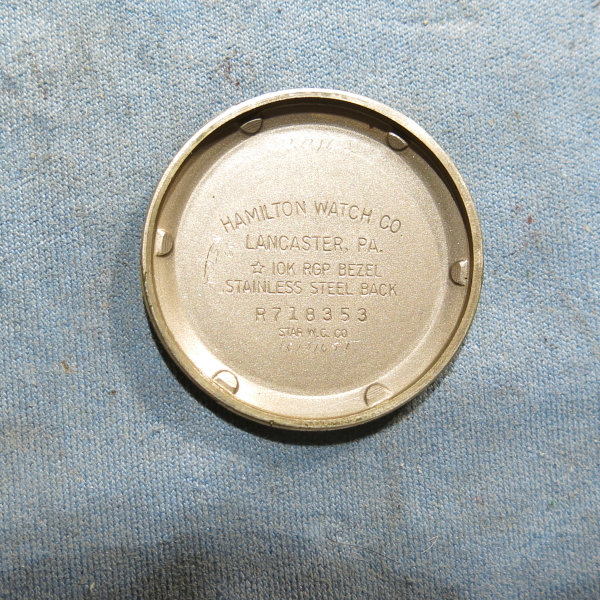
The Gardner came in a 10K RGP case with a stainless steel back. It's an entry-level watch but that doesn't mean it was inexpensive. $40 in 1959 was like $300 today.
To keep the price point competitive, Hamilton used Swiss-made movements in their entry-level models and the Gardner uses a 17 jewel 673 grade which is based on an A. Schild 1200 movement. Even though the movements were imported, that doesn't mean they were low quality. They were just less expensive than watch movements made in Lancaster, PA. The finishing of the movements isn't extravagant but they are fully jeweled, well-made movements. Some Swiss movements were put in solid gold cases and every Hamilton Automatic had a Swiss-made movement.
My project watch was outfitted with triangular shaped hour markers at the odd-numbered positions. Normally these positions would have had an embossed simple bar. The crystal was cracked and the slender lugs have been splayed out by a poorly fitted strap and / or spring bars.
The stainless steel case back is unadorned and pops off with a little pressure applied to the lip between the lower lugs.
The 673 is a very basic mechanical movement. The escape wheel has a cap jewel on the train bridge and the main plate is not jeweled at the center wheel - that keeps the jewel count at 17.
The dial is textured with concentric rings. It beds down at the corners slightly and the coloring and finish looks a little off on the edges. I really can't do much to improve the looks of the dial, unfortunately. Any cleaning or aggressive treatment will likely lose the printing and make the dial look worse. So I'll try to keep the dial as-is.
The mainspring barrel has a glob of mainspring grease that has hardened. That's a sure sign this watch is long overdue for a trip to a watchmaker. When old gels into a solid, the dirt and grime in the oil will accelerate the wear of the most delicate parts of a movement. Just because the watch runs, doesn't mean it's in good shape.
While everything is in the ultrasonic, I'll prep a new glass crystal for installation. This crystal is square and 25.1mm by 25.1mm.
I recently received a question from a blog follower about how a main spring winder works, or how to use one. So I'll show you step-by-step.
First, you need a winder and there are several different styles. The process is fairly easy, you wind the spring into a holder and then press the spring from the holder into the mainspring barrel. So you need to first find a winder with a holder approximately the same size (or slightly smaller) than the barrel. I like to use K&D style winders, as their holders are adjustable and they come in three sizes so you can cover a broad range of barrels.
The center of the spring has a hole in it to accept a tang on the barrel arbor. So you need to use an arbor to wrap the spring around when you're winding it into the holder. Notice the little post sticking out of this arbor... the hole in the spring will grab onto this post.
Next, you want to make sure you put the spring onto the arbor in the right direction so you don't end up winding the watch backwards. The vast majority of the time the mainspring is wound clockwise around the winding tool arbor. So you position the end of the spring with the hole on the arbor and lock the spring onto the post.
The arbor slides into the holder and the openings in the holder allow the spring to pass through. Now when you rotate the holder clockwise, the spring will slowly be drawn into the holder.
Once the spring is "sucked up" into the holder like a piece of spaghetti into your mouth, just a few millimeters of the end should be sticking out. This end of the spring typically is one of two styles... US made movement will have a T-end or a post on each side that will go into a hole in the barrel. Swiss-made grades have a ledge recessed into the side that a young on the spring will catch hold of. You can see the tongue of this spring sticking upward at the end of this spring.
Before I insert the spring in the barrel, I'll put a little mainspring grease in the barrel. It doesn't take much, just a tiny tab so the arbor will be lubricated (once it's installed) and the spring will slide inside the barrel. The spring floats inside the barrel and is constrained only on the each end... one end on the arbor and the other end on the outer wall of the barrel. Automatic movements have a clutch inside the barrel so the spring will actually slip inside the barrel once it's fully wound - that allows the watch to keep on winding while it's worn. When you wind the watch, the spring is drawn to the center (arbor) and as it unwinds it moves outward. I've had this same bottle of grease for about 5 years.
To install the spring in the barrel, you first align the spring in the holder with the corresponding position of the barrel you want to push the spring into. Once the spring is free of the holder, it will expand into the wall of the barrel so getting it close is important... otherwise you have to remove the spring, wind it again and the reinstall it.
Getting the mainspring arbor back into the barrel can sometimes be a challenge. I like to use my most stout tweezers but you can't squeeze too hard - a hard squeeze could result in a lost arbor, should it come loose of the tweezers. Notice the arbor has a tang on the side - that goes into the hole of the mainspring.
There... the arbor is installed. Now I'll apply just a little more grease and push the cover back on.
The cover needs to snap on fully so the barrel won't drag inside the movement. The teeth on the barrel drive the center wheel in this watch... this is technically the "first wheel".
The movement is cleaned and dried and ready to go back together.
The reassembled movement goes onto the timer... good amplitude, decent beat error and just 29 seconds fast per day beat rate. It's not as easy to adjust the beat error on this movement as it is on the ETA grades from the same era... so I'll leave that as-is but a tweak to the regulator can slow the watch down a smidgen.
There... nothing too shabby about this performance.
I straighten the lugs gently after installing the new crystal. This watch is from an era of dimensions in inches. So this watch should have an 11/16 inch strap. That's 17.4mm so a 17mm strap is a bit narrow and an 18mm is too wide. Since the watch has an 18mm strap, I'll trim a little sliver off each side so that it will fit better and use 17mm spring bars so there's less pressure to push the delicate lugs outward.
And here's the finished project... a new crystal always makes a watch look dramatically better and the straightened lugs are a nice improvement too. The dial is a little better but there's only so much one can do with a textured dial. Overall, it was a good project I think, I'm sure this watch's owner will be happy with the results.
Information about vintage Hamilton watch repair, restoration, models, and advice for collecting and collectors
Welcome
Greetings!
Saturday, March 12, 2016
Sunday, March 6, 2016
1956 Accumatic II with Reserve Meter
If you've followed this blog a while you have probably seen that Hamilton's first automatic models were actually a part of the Hamilton Illinois brand. Hamilton acquired the Illinois Watch Company in the late 1920's and the older Illinois watches are highly collectible. They are certainly on par with Hamilton watches from the same era and Hamilton even adopted one of the Illinois 12/0 sized movements for use in Hamilton models in the early 1930's. The Great Depression brought the demise of the Illinois line until the brand was briefly reintroduced about 20 years later.
It would appear that many collectors don't know what to think about the Hamilton Illinois watches. They're really not Illinois watches in anything other than name - as that company was long gone by the 1950s. They're not entirely Hamilton models either... they used Swiss ébauche movements, after all. (Perish the thought!) I suppose you could think of the Hamilton Illinois watches as being from the land of misfit toys.
Well-informed collectors would realize that the Hamilton Illinois models were actually rather innovative and brought a number of "firsts" to Hamilton... the first shock jeweled models, the first calendar models, the first automatics, the first use of rolled gold plate and the first use of a power reserve meter on a wrist watch. These aren't firsts for the industry, just for Hamilton's lineup.
Hamilton had a couple of Illinois-branded automatics with a power reserve meter, or wind indicator as it's sometimes called. The models were called the Signamatic A and Signamatic B.
The Illinois line was produced from 1953 through 1955, after which it was just absorbed into Hamilton's line up. I guess the world didn't stop spinning because Hamilton offered Swiss movements - so executives agreed to use the Hamilton name on all models.
In 1956 Hamilton introduced a new line of automatics called the Accumatic. One of the first entrants was the Accumatic II. It featured a Hamilton 672 movement based on an ETA 1256 grade.
Hamilton must have had an abundance of imported Illinois movements so a lot of 1956 models have Illinois branded movements inside. Most of the time the model with an Illinois grade is called a "-B" model.
Well, I've seen a good many uncatalogued Hamilton automatics with a reserve meter and I bet you have too. You don't see them every day but they are not uncommon. I finally landed one and I think it looks the most like an Accumatic II. Perhaps it should be called an Accumatic II-B, since it uses an Illinois-branded movement... the same grade used in the Sigmatic models. I'd be willing to wager it was only available in 1956 and was used to exhaust the remaining inventory of movements on hand in Lancaster.
The case is definitely an Accumatic II case. There's no doubt about that. The dial is very similar to the Accumatic II but if you've got an eye for details you'll see the fonts of the numerals are a little different, as are the style of the hands. Here's a photo of the Accumatic II for comparison.
Anyway, the case back is stainless steel and is easy to unscrew and open.
The Illinois-branded movements didn't get special names. You'll often see them referred to as a "TXD", as seen on the balance cock. That's actually the import code for Illinois and all Illinois movements say TXD on the balance cock, regardless of calibre. Usually the caseback has a number on it that indicates the model. But not this case (pun indended).
Looking at the movement below, there's nothing on the reverse to make you suspect this watch has a power reserve complication. It looks like a garden variety ETA 1256 and if you look on eBay for "ETA 1256" you'll find that it was used by many different watch brands.
The watch case is clearly a Hamilton branded case.
Removing the dial reveals a fairly unremarkable main plate. That's because it's covered by a ring that supports the reserve wheel. The only point of interest is that there's a screw missing at 2:00.
Once you lift off the reserve wheel and spacer ring, you can see the main plate is fairly complicated with a series of gears and pinions to transfer the motion of the mainspring barrel to the reserve wheel. When the watch is fully wound it will show 40 hours and slowly work it's way down to zero as it runs... as long as you don't wind it.
With the back of the movement cleared of parts, you can see there is a gear between the barrel and the main plate that engages a special mainspring arbor with matching teeth. When the watch is wound it will turn this gear and as the watch is running, the mainspring barrel will slowly turn and the wheels on the front of the watch will rotate the reserve wheel back down to zero. It's a fascinating little mechanism, isn't it?
Everything is cleaned and ready to be reassembled.
I'll wind the watch fully to verify that the reserve wheel is functioning correctly.
With the watch fully wound, I put the balance back into place and the watch is now ticking away.
The movement is running a little fast but that's easy to adjust. The beat error is just under 200... that may be because of the extra energy that all the other parts are requiring... or the mainspring just doesn't have the resiliency it may have originally had.
A little tweaking of the regulator gets the timing to fall back in line. I tend to leave watches running a little fast as they will settle down eventually.
The oscillating weight goes back onto the movement and the assembly goes back into the freshly cleaned case.
I relumed the hands and put a fresh lizard strap on and this 60 year old watch is looking, well, not a day over 50. It actually looks a lot better than my camera makes it appear. Now I just need to watch it for 40 hours to confirm it unwinds to zero.
UPDATE:
Well sure enough, I had a fellow collector me who has an affinity for the Hamilton Illinois niche contact me with a photo of the inside case back of one of his watches like this one - and the inside says "Accumatic II "B"".
How was that for a good guess?
It would appear that many collectors don't know what to think about the Hamilton Illinois watches. They're really not Illinois watches in anything other than name - as that company was long gone by the 1950s. They're not entirely Hamilton models either... they used Swiss ébauche movements, after all. (Perish the thought!) I suppose you could think of the Hamilton Illinois watches as being from the land of misfit toys.
Hamilton had a couple of Illinois-branded automatics with a power reserve meter, or wind indicator as it's sometimes called. The models were called the Signamatic A and Signamatic B.
The Illinois line was produced from 1953 through 1955, after which it was just absorbed into Hamilton's line up. I guess the world didn't stop spinning because Hamilton offered Swiss movements - so executives agreed to use the Hamilton name on all models.
In 1956 Hamilton introduced a new line of automatics called the Accumatic. One of the first entrants was the Accumatic II. It featured a Hamilton 672 movement based on an ETA 1256 grade.
Hamilton must have had an abundance of imported Illinois movements so a lot of 1956 models have Illinois branded movements inside. Most of the time the model with an Illinois grade is called a "-B" model.
Well, I've seen a good many uncatalogued Hamilton automatics with a reserve meter and I bet you have too. You don't see them every day but they are not uncommon. I finally landed one and I think it looks the most like an Accumatic II. Perhaps it should be called an Accumatic II-B, since it uses an Illinois-branded movement... the same grade used in the Sigmatic models. I'd be willing to wager it was only available in 1956 and was used to exhaust the remaining inventory of movements on hand in Lancaster.
The case is definitely an Accumatic II case. There's no doubt about that. The dial is very similar to the Accumatic II but if you've got an eye for details you'll see the fonts of the numerals are a little different, as are the style of the hands. Here's a photo of the Accumatic II for comparison.
Anyway, the case back is stainless steel and is easy to unscrew and open.
The Illinois-branded movements didn't get special names. You'll often see them referred to as a "TXD", as seen on the balance cock. That's actually the import code for Illinois and all Illinois movements say TXD on the balance cock, regardless of calibre. Usually the caseback has a number on it that indicates the model. But not this case (pun indended).
Looking at the movement below, there's nothing on the reverse to make you suspect this watch has a power reserve complication. It looks like a garden variety ETA 1256 and if you look on eBay for "ETA 1256" you'll find that it was used by many different watch brands.
The watch case is clearly a Hamilton branded case.
Removing the dial reveals a fairly unremarkable main plate. That's because it's covered by a ring that supports the reserve wheel. The only point of interest is that there's a screw missing at 2:00.
Once you lift off the reserve wheel and spacer ring, you can see the main plate is fairly complicated with a series of gears and pinions to transfer the motion of the mainspring barrel to the reserve wheel. When the watch is fully wound it will show 40 hours and slowly work it's way down to zero as it runs... as long as you don't wind it.
With the back of the movement cleared of parts, you can see there is a gear between the barrel and the main plate that engages a special mainspring arbor with matching teeth. When the watch is wound it will turn this gear and as the watch is running, the mainspring barrel will slowly turn and the wheels on the front of the watch will rotate the reserve wheel back down to zero. It's a fascinating little mechanism, isn't it?
Everything is cleaned and ready to be reassembled.
I'll wind the watch fully to verify that the reserve wheel is functioning correctly.
With the watch fully wound, I put the balance back into place and the watch is now ticking away.
The movement is running a little fast but that's easy to adjust. The beat error is just under 200... that may be because of the extra energy that all the other parts are requiring... or the mainspring just doesn't have the resiliency it may have originally had.
A little tweaking of the regulator gets the timing to fall back in line. I tend to leave watches running a little fast as they will settle down eventually.
The oscillating weight goes back onto the movement and the assembly goes back into the freshly cleaned case.
I relumed the hands and put a fresh lizard strap on and this 60 year old watch is looking, well, not a day over 50. It actually looks a lot better than my camera makes it appear. Now I just need to watch it for 40 hours to confirm it unwinds to zero.
UPDATE:
Well sure enough, I had a fellow collector me who has an affinity for the Hamilton Illinois niche contact me with a photo of the inside case back of one of his watches like this one - and the inside says "Accumatic II "B"".
How was that for a good guess?
Saturday, March 5, 2016
1964 Accumatic A-602
After my last post of a Thin-o-matic with a micro rotor movement I decided to take it easy on myself so I could recover. I have a couple of manual-winding projects to get to but they're waiting on new crystals. The best I could do was come up with a more traditional automatic, but it's an interesting model nonetheless.
The 1964 Accumatic A-602 is a nice looking model, so nice looking that it's hard to believe it was a one-year wonder and only made for a single year.
You can't really tell from the catalog depiction what makes the A-602 so interesting. It has a three-tone dial with a parchment-colored field and a two-part silver chapter ring outfitted with gold hour markers. There is a lot of sparkle to this watch, so much so that I would be tempted to put one of those faceted crystals on the watch, just so I could see what it looked like.
Tucked inside the case is a 17 jewel 689 movement made by ETA.
My project watch arrived in average condition. It could stand a new crystal and the Speidel bracelet looked nice but it has to go, as the expansion ends that are designed to accommodate various lug widths and are spring loaded. They will wear grooves into the lugs over time.
The case back has a deep pie-pan shape - a sure sign there's an ETA movement inside.
Like a lot of Accumatics, the A-602 opens through the crystal. "The Claw" is my go-to tool for this type of application and even though the last watchmaker glued the crystal on, I was still able to break it loose. The things people will do to avoid buying the right part... this crystal is about 0.5mm too small for a proper fit. That's okay though, I was planning on replacing it anyway.
The gaskets in the crown aren't very good so some moisture has gotten into the stem tube and rusted the stem slightly. Otherwise the movement looks good.
However, it sure was dirty... check out how cloudy the cleaning solution got after 6 minutes in the ultrasonic. It's rare that one movement will make a baby food jar of cleaning solution this dirty. This is why it's always a good idea to get any new project watch overhauled before wearing it.
Everything is cleaned and then rinsed twice before being thoroughly dried. Now it's time for reassembly with fresh lubricants. This movement uses two types of oil and two types of grease in various places.
The partially reassembled movement is purring away so it's off to the timer to see how well it's running.
The amplitude of 230 is great, the beat rate is a little fast and the beat error of 1.7ms is acceptable in most situations but this watch is very easy to adjust so I can really fine tune it.
First I'll tackle the beat error. That's adjusted by moving the position of the hair spring stud on the balance cock one direction or the other. If it gets worse, I need to go the other direction.
There - it doesn't get much better than 0.1ms, although 0.0 is obtainable. It takes such a small adjustment that it's just as likely that I make it worse. So I'll stop here and move on to adjusting the regulator . By moving the regulator I can make the hair spring ever so slightly longer and slow the beat rate down.
The two lines look like one line since the beat error is so low and they are almost horizontal so I'll stop here. Four seconds fast per day is a totally acceptable beat rate for a watch from this era, in my opinion.
The oscillating weight goes back on the reverse of the movement and the dial goes back on the front. Then the assembly can go back into the case so I can use the crown to position the hands at 12:00 when I install them.
A new 29.3mm GS PHD crystal will do nicely to seal the watch and protect the dial and hands.
A new lizard strap completes the watch's restoration and this A-602 is a true beauty.
And best of all, it came with its original box and paperwork. Thats always a nice addition.
The 1964 Accumatic A-602 is a nice looking model, so nice looking that it's hard to believe it was a one-year wonder and only made for a single year.
You can't really tell from the catalog depiction what makes the A-602 so interesting. It has a three-tone dial with a parchment-colored field and a two-part silver chapter ring outfitted with gold hour markers. There is a lot of sparkle to this watch, so much so that I would be tempted to put one of those faceted crystals on the watch, just so I could see what it looked like.
Tucked inside the case is a 17 jewel 689 movement made by ETA.
My project watch arrived in average condition. It could stand a new crystal and the Speidel bracelet looked nice but it has to go, as the expansion ends that are designed to accommodate various lug widths and are spring loaded. They will wear grooves into the lugs over time.
The case back has a deep pie-pan shape - a sure sign there's an ETA movement inside.
Like a lot of Accumatics, the A-602 opens through the crystal. "The Claw" is my go-to tool for this type of application and even though the last watchmaker glued the crystal on, I was still able to break it loose. The things people will do to avoid buying the right part... this crystal is about 0.5mm too small for a proper fit. That's okay though, I was planning on replacing it anyway.
The gaskets in the crown aren't very good so some moisture has gotten into the stem tube and rusted the stem slightly. Otherwise the movement looks good.
However, it sure was dirty... check out how cloudy the cleaning solution got after 6 minutes in the ultrasonic. It's rare that one movement will make a baby food jar of cleaning solution this dirty. This is why it's always a good idea to get any new project watch overhauled before wearing it.
Everything is cleaned and then rinsed twice before being thoroughly dried. Now it's time for reassembly with fresh lubricants. This movement uses two types of oil and two types of grease in various places.
The partially reassembled movement is purring away so it's off to the timer to see how well it's running.
The amplitude of 230 is great, the beat rate is a little fast and the beat error of 1.7ms is acceptable in most situations but this watch is very easy to adjust so I can really fine tune it.
First I'll tackle the beat error. That's adjusted by moving the position of the hair spring stud on the balance cock one direction or the other. If it gets worse, I need to go the other direction.
There - it doesn't get much better than 0.1ms, although 0.0 is obtainable. It takes such a small adjustment that it's just as likely that I make it worse. So I'll stop here and move on to adjusting the regulator . By moving the regulator I can make the hair spring ever so slightly longer and slow the beat rate down.
The two lines look like one line since the beat error is so low and they are almost horizontal so I'll stop here. Four seconds fast per day is a totally acceptable beat rate for a watch from this era, in my opinion.
The oscillating weight goes back on the reverse of the movement and the dial goes back on the front. Then the assembly can go back into the case so I can use the crown to position the hands at 12:00 when I install them.
A new 29.3mm GS PHD crystal will do nicely to seal the watch and protect the dial and hands.
A new lizard strap completes the watch's restoration and this A-602 is a true beauty.
And best of all, it came with its original box and paperwork. Thats always a nice addition.
Subscribe to:
Posts (Atom)