Welcome


Greetings!

Thanks for visiting my vintage Hamilton watch blog. I like to restore US-made Hamilton wrist watches back to their original glory and share my experiences with other enthusiasts. Use the "Search" space below if you know what model you're looking for. Feel free to leave polite comments or questions in the spaces provided. Also check out my "watches for sale" on my Etsy site - the link is on the right, just below.

Saturday, December 10, 2016

1964 Fairlane

There are a number of non-catalogued models in pretty much every decade going back to the 1920's. Eventually in the 1950's Hamilton also operated an awards division and they produced unique models that were often similar to catalogued models but different enough to not be identical.  So it's not unusual to see legitimate Hamilton models that are hard to identify.

If you see "Masterpiece" on the dial, it's a sure sign the watch is an awards division model.

There is one model that I've seen quite a few times but wasn't able to identify.  Eventually another collector I know landed one that came in it's original box and the box identified it as a "Fairlane".


Now the interesting thing about this model is the only time you see it there is always an engraving on the back from Ford Motor Company.  So it's an interesting model, probably from the awards division but it has a known model name.  The earliest example I've seen is from 1964, so I'll call it the 1964 Fairlane.

It's interesting that the model is named Fairlane - that's a pretty wise choice since the Ford Fairlane was a popular model from 1955 through 1970.  That's before my time though so my mind immediately goes to the 1990 movie "the Adventures of Ford Fairlane", staring Andrew Dice Clay and Priscilla Presley.  Don't remember it?  You're not alone.


The Hamilton Fairlane came in a solid 10K gold case.  Looking at it I've always assumed it would be one of the Stormking models.  


It's a bit of a blend between the Stormking VIII and the Stormking XI.


Like the Stormking models, the Fairlane uses a US-made Hamilton 8/0 sized movement - and more specifically the 736 grade.

My project watch arrived in nice shape, a little beat up but nothing too distracting.  The back of all of the examples I've ever seen are nicely engraved with a presentation from Ford.  This example is from 1968.  It will look better after the case is lightly polished.


The case is opened through the crystal and you can see the movement is supported by a rather substantial movement ring.  The 736 is basically a 735 but with a glucydur balance.  Note that the balance wheel has no timing screws going around the outside.   This balance is factory poised so if you break the balance staff you might as well replace the balance, as you can't make any adjustments to the balance weight.


I can tell from the inside of the case that this watch has been serviced a few times over the last 50 years.


Everything is laid out to dry after being cleaned.


The reassembled movement sparkles after being cleaned.  I think the 736 and the 731 are probably the finest movements Hamilton made.  You can add the 770 to the trio because by the end of the 1960's it too had a glucydur balance.  Oddly, the 770 didn't become a 771 when the balance changed while the 730 and 735 became the 731 and 736.  Go figure.


Whoa!  This beat error is way too high.  I thought initially by the distance between the lines that it would be 3-ish but it turns out the lines are so far apart that the bottom line is actually the "top" line.


Adjusting the beat error means centering the balance with the pallet fork and that requires removing the balance from the balance cock and rotating the hairspring appropriately.  I got it much better on my first try... normally it take several guesses.  Now I just need to speed it up a little.


There, with the mainspring fully wound the amplitude is vigorous and the beat error is 1 ms.  Not too shabby.


A new GS PHD crystal in 30.6mm and a fresh lizard strap complete the overhaul.  This Fairlane turned out great.  It's a good sized watch too, as you could probably guess by the size the movement ring that supports it.


And here's the back of the case and the presentation for 35 years of service to Ford Motor Co.  Henry Ford even signed it (not).


Sunday, December 4, 2016

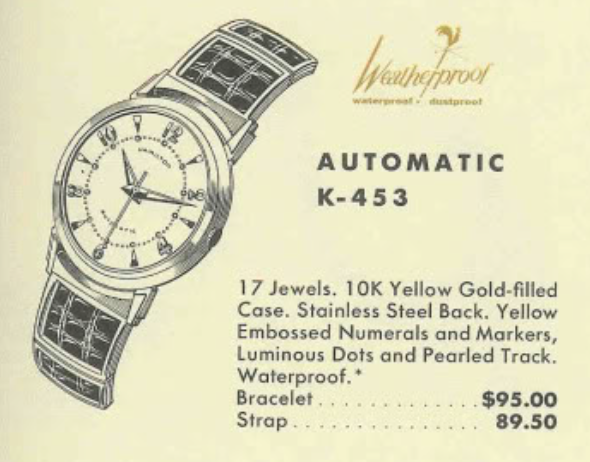
1957 Automatic K-453

There are a lot of K-series automatic models, 59 to be exact.  There are even more Accumatic and Thin-o-matic models, well over 80 of each when you consider the calendar models too.

I've done 39 of the 59 K-series models and I've got my 40th ready to add to the list.  It's a 1957 Automatic K-453.  This model was produced for three years.


The K-453 came with a 10K gold filled bezel and a stainless steel back.  The dial has embossed numerals and markers and there's a pearled gold track inside the hour markers.  There are luminous dots at each hour and the hands are open dauphine-style with lume inside.

Like most K-series models, you will find the 17 jewel 661 movement inside.

I suppose it's safe to say that I've found most of the commonly found Automatics.  I've gotten to the point where beggars can't be choosers and I go after especially rough models just so I can add them to the list of models I've located.

That's what happened with my K-453 project watch.  It was rough and I thought the worst case would be I'd have a spare parts movement.  It wasn't running, the dial was burned by the radium on the hands and it just didn't look promising.


I like this style of screw off stainless steel back.  There's a lot of meat for the case wrench to grab ahold of.  I couldn't get this watch open until I soaked it with penetrating oil.


The old gasket inside enclosed the case back like glue.  At least the movement is in good shape.  I can wind and wind and wind it without resistance, so I suspect the mainspring is broken.


The inside of the case back is properly marked, even if it doesn't say what model it is.  Just knowing the case is gold filled with a stainless back would indicate it's a 450-something.  If it was solid 10K gold with a stainless back it would be a 350-something.  Solid 14K with a stainless back is a 250-something.


Without the beat-up old crystal in the way, the dial looks like it might be salvageable.  There's not much I can do about the radium burn but I can clean of the radium from the hands and dial in the ultrasonic.  That will at least end the damage.


Sure enough, the mainspring is broken.  Sometimes I get lucky and find the arbor just came disconnected from the spring.  However, you can see the arbor is still connected and the first coil broke.


Automatic mainsprings are designed to slip in the barrel and the last coil has a spline to push the end against the barrel.


Fortunately I have a replacement mainspring.  Installing these is similar to a regular mainspring but getting the spline into the barrel can be a pain.


Success!  A little mainspring grease is added and I can reinstall the arbor in the center.


A new crystal is definitely called for.  A 28.3mm diameter GS PHD will do the trick.


Everything is cleaned and dried... everything except the cannon pinion and the hour wheel, that is.  They seem to have disappeared.  I found the hour wheel after a little searching and the cannon pinion is missing in action.  Fortunately I have a spare.


The reassembled movement is running nicely so it's off to the timer.


It's running a little fast but a slight tweak to the regulator will fix that.


I'll leave it here for now.


I have to admit that I pulled a rabbit out of the hat with this watch.  It actually turned out really well.  The dial still shows a slight burn but it has a nice even brownish tone that goes nicely with a brown lizard strap.


A little fresh lume goes a long way toward brightening up a dull dial and hands.  This luminous paint needs to be charged by light but it will glow for a little while.


It would have been interesting to see what radium paint was like back in the day.  It glowed 24x7... kind of eerie when you think about it.  Radium was at one time considered "a wonder material" and used in things like tooth paste, etc.  Turns out it can also kill you.  It's easy to get wigged out by radium but the dial, case and crystal block the radiation so you don't need to worry about it unless you eat the watch.  You don't really want to handle it though - which is why I will typically remove it in the ultrasonic cleaner.

Saturday, December 3, 2016

1961 Pacermatic (Pacer A)

Every watch collector has a "grail", as in the Holy Grail, that is a model they would love to have in their collection.  One of my grail models would be the 1961 Pacermatic, also called the Pacer A.

The Pacermatic was only made for a single year.  From the outside, it looks like the original Pacer.  The Pacer was an Electric model and I would call it "the poor man's Ventura", because it looks a lot like the solid 14K gold Ventura model.  In fact, the Ventura and the Pacer share the same crystal.  The Pacermatic is a Pacer with an automatic movement inside.


What makes the Pacermatic special is it's one of the most unique asymmetric mechanical models.  I think the only models that bests the Pacermatic is a Flight I or the Automatic K-475... they remind me of something George Jetson would wear.


Today a Pacermatic will cost you big bucks... probably $2,500 or more for a nice example.   You might even go so far as to say the Ventura is now the "the poor man's Pacermatic.  Considering it comes in a gold filled case with a Swiss-made movement, the value of a Pacermatic is pretty impressive.  It also proves that you can't turn up your nose at models with Swiss-made movements.  They have their place in Hamilton's heritage.

A regular old Pacer, which is also a very nice watch, is more like $800 and the Pacermatic shares the same case.  As a result, there are quite a few fake Pacermatics out there.  I'll tell you below how to spot a true Pacermatic so you don't get fooled by "a deal too good to refuse".

Now, I don't have $2,500 to spend on a single watch, so I try to live vicariously through others.  Having restored well over 500 models, I've earned the trust of a few fellow collectors.  One recently came into possession of a Pacermatic and he sent it to me for an overhaul.

As received, it wasn't much to look at.  I didn't ask him what he paid for it but my first impression led me to wonder how many super-rare watches like this have been tossed away or are sitting in shoebox somewhere.

Looking at the case, the lugs are silver in color and the bezel is yellow.  This dial looks really bad, and the photo makes it look better than it is.


The back of a Pacer looks just like the back of a Ventura, the only difference is the material.  In fact, you could pop a gold filled Pacer back onto a solid gold Ventura or a solid gold Ventura back onto a Pacer.  A Pacer will often show wear to the tip of the point opposite the crown, and this one shows just a sliver of wear in that spot.


This watch came on a Hamilton strap.  I don't know if this is the original strap but I suspect that it is.


Wth the crystal out of the way you can see the dial is in rough shape.  There is some wear on the right side, I suspect from the crown not supporting the stem in the case, so the dial and movement can rotate a few degrees.  I think the crown needs to have a longer tube so it will fill the case opening a little more fully.

This is a good opportunity to point out a few of the tells of an authentic watch.  The word automatic should be in script and all lower case letters.  Dials can be refinished and it's okay for a Pacermatic to have a refinished dial but the script has to be correct.  Also, the lines going into the hour markers should be well centered.


A Pacermatic should have a 17 jewel 667 movement.  All of the K-series automatics from 1961 used this grade too, so it's not a rare movement.  The movement fits in a special movement ring and the ring has a step on the outside so that it will sit in the case back and provide room for the rotor to spin without hitting the case back.  An authentic Pacermatic needs to have this ring.


Okay - here's the real tell for an authentic Pacermatic.  Cases for the Pacermatic came in two batches so their serial number falls into two ranges.  The case serial number should fall into the range of 528500-528800 (300 of in this run) or 637700-638200 (500 in this run).  Based on the range of the serial numbers, you can assume there were a total of 800 Pacermatics made.  This case falls comfortably in the middle of the second batch of numbers.


You might come across a Pacermatic with a back outside these ranges.  If so, you should assume maybe it's authentic and maybe not.  It's quite possible the original back was damaged and a regular Pacer back was used for substitution.  As long as the rest of the watch is authentic, I wouldn't worry too much about the case back but you should make sure the other parts are the real deal.

Getting the movement ring off requires finding a spot to pry the movement out.  You don't want to use the dial as a leverage point.  Here is a dial foot hole and it served as a good fulcrum to separate the ring from the movement.


The rotor on a 667 comes off easily, just like on it's predecessor, the 661 movement.  They look like the same movements when the rotor is removed and they share most of the same parts.


Here's true test of a Pacermatic.  The dial foot locations for a 667 are not the same as an Electric 505 movement.  Therefore, you should make sure the dial feet have not been removed and soldered on in a different spot.  This dial shows no numbers or anything unusual and I'm 99.9% sure it's original and I'm 100% sure it's a Pacermatic dial.


This shot is a little blurry but you can still see that this is one dirty movement and is long overdue for a bath.


Everything is cleaned and dried.  I checked with the owner to see if he was open to getting the dial refinished.  If he was, I'd be willing to try to clean it.  If he wasn't, I'd leave it as is.  I have learned, more than once, to not clean a dial that I'm not willing to get refinished.  You can very easily screw up a crappy dial and make it even more crappy.   He was okay with getting the dial redone so I cleaned this one and I think the results were okay.  You can't really tell in the photo below and I need to put the movement back together before you can see how it turned out.


Okay - everything looks good and the watch is ticking away nicely.  Off to the timer.


It's running a smidgen fast but I like everything else I see.  I'll let it run for a while before I try to adjust it.  The performance will change as the watch settles in after an overhaul.


And here is the finished project.  My darn light tent really accentuates the remaining tone of the dial.  I could try cleaning it further but that risks losing the printing.  It looks way better in regular light.


Here's a wrist shot of the watch in better lighting.  I think the overall watch looks great and I'm very pleased with how it turns out.   If it was my watch I would leave the dial as is - it's only original once.


Although this Pacermatic isn't my watch, I have to say that just being able to restore one was enough to satisfy my desire for a grail.   As the stamp dealer in the movie "Charade" said, "For a few minutes it was mine, that is enough".