Welcome


Greetings!

Thanks for visiting my vintage Hamilton watch blog. I like to restore US-made Hamilton wrist watches back to their original glory and share my experiences with other enthusiasts. Use the "Search" space below if you know what model you're looking for. Feel free to leave polite comments or questions in the spaces provided. Also check out my "watches for sale" on my Etsy site - the link is on the right, just below.

Saturday, July 6, 2024

1961 M69-1

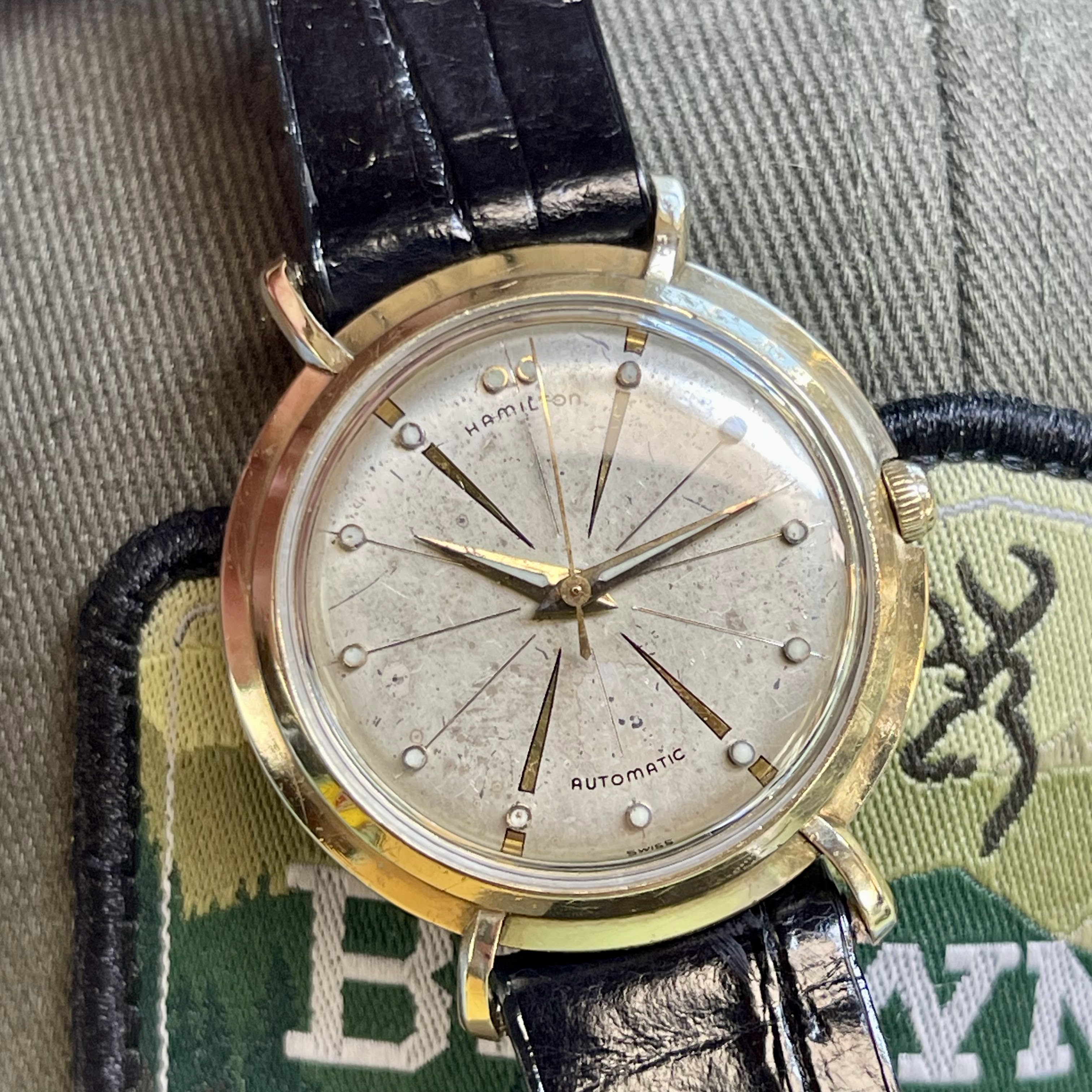
One of the more obscure lines of Hamilton watches are the M-series.  There's also an F-series for ladies.  The M-series only showed up in the 1964 catalogs but they're believed to be made starting in 1961 and going into the mid 1960s.

If you didn't already know, you can find the catalogs on this page in my blog.  Check out the last page of the 1964 catalog to see the various M models.

The nomenclature used for the M series is the first number is the retail price of the watch.  The second number is the order the model came in that price.  So an M69-1 was the first model priced at $69.  1964 shows there was an M69-2 and an M69-3.  So the M69-1 was introduced before 1964.


One way to spot an M-series model is if it comes with it's original box.  The M-series (and F, as well) came in a red clamshell box.   The shape of the box is similar to the usual cream-colored Hamilton boxes but the color is red - so they're very easy to spot.  Here's a couple of example photos from eBay, right now.


Anyway, my belief is these models were distributed through a nationwide retailer.  Perhaps Sears, or Service Merchandise, or some other catalog-store that no longer exists.  Large enough to offer high end products that a quality jewelry store would offer.  I'm sure that Hamilton executives would be willing to offer a specialized product line that would not interfere or compete with their existing network of high end jewelry retailers.  That's just my opinion though, take it for what it's worth.

I've already done a post on the M69-1 but it's been a while and this one is actually a little different.  One thing is the same and that's that I received it without a crown.  This is a pretty common ailment of watches with a one-piece case.


The stem tube has a flat spot on it and I see no signs of the stem.  It'll be a two piece stem since this watch opens through the crystal.  So the crown side of the stem is probably still attached to the crown - wherever that is.


The case is interesting in that the lettering inside is a little crooked.  You don't see that very often, at least in my experience.  There are several service marks inside so this watch has been overhauled a few times before the crown disappeared.  The number inside is unique to this case but means very little to anyone but the Star Watch Case Co.  Presumably there's a P420106 or a P420108 out there somewhere.  My last M69-1 had the serial number P755427.  That doesn't imply there are 350,000 M69-1's out there though.  But there are likely at least two batches of cases for this model - assuming it's not shared with another Hamilton model.


This example has a 17 jewel 678 caliber inside rather than a 688.    The 678 preceded the 688 and they look very similar.  The main difference is the balance cock design and the balance.  You can see in the photo below that this balance has weights and a fixed hairspring stud on the balance cock.  When the 688 was introduced, it features a Glucydur balance and the hairspring stud was moveable.  That was a much improved design and made adjustments a breeze.


The female-side of the two piece stem is still present.  So all I need is the male side and a replacement crown.


From the dial-side of the main plate, this movement looks identical to the 688 movement.


If you didn't already know, you can tell this movement was made by ETA and it's based on a 2391 caliber.  So if you needed a part, any 2391 would serve as a donor, whether it was Hamilton or not.


Everything is cleaned and dried.  Time for it to be reassembled with fresh lubricants.


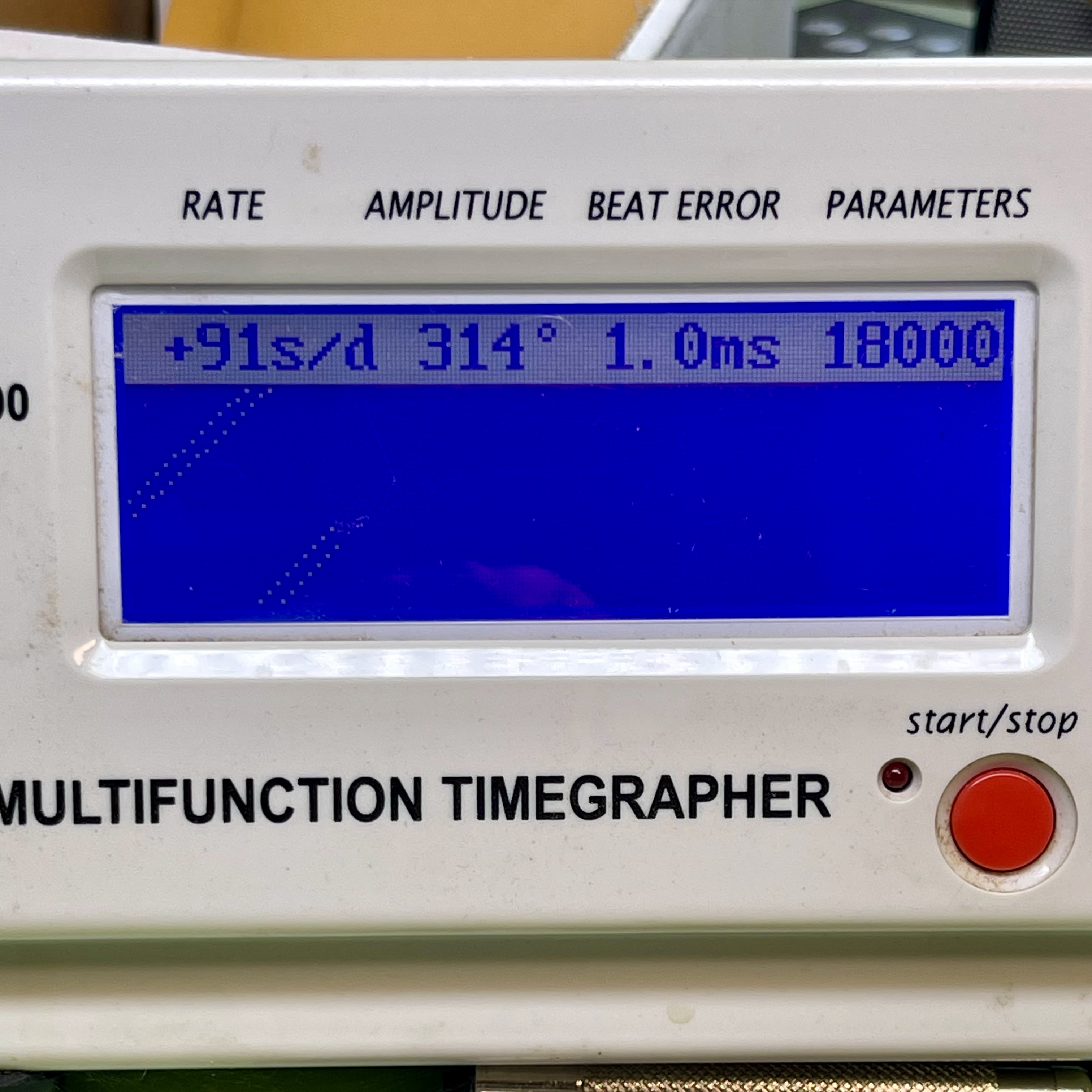
The sparkly movement is ticking away with a good motion.  Let's see what the timer thinks of it.


Not too shabby.  The beat error of 0.9ms is well within my specs but the hair spring stud is fixed on the balance cock so it would be very challenging to reduce it.  On a 688 it would be easy to fine tune but on a 678 I'll let sleeping dogs lie.


The male side of the stem is referred to as a "hub".  If you need to find one, look on eBay for a "Tap 10 male stem hub" and you'll see lots of examples.  The trick is to trim it to the proper length.  Tap 10 is the thread size for the crown.  If the crown was tap 8, you'd need a tap 8 stem hub.  After 1952 pretty much every Hamilton crown is tap 10.

The most common question I get from people is "what crown do I need for my watch?".  That's a very difficult question to answer.  Like the Supreme Court's definition of pornography, you know it when you see it.  In the case of a crown, there are so many factors.  For example, what thread size, is it water proof, how large is the stem tube, is there a gasket, does it recess into the case, how tall should it be, etc. etc. etc.?   

For this watch, I went with what looks best and fits best.


My finished project looks fantastic with a new crystal and a genuine lizard strap.  The crown is a perfect fit.  It looks like it just left the showroom floor.  All it needs is a red clamshell box.

Friday, July 5, 2024

1956 Transcontinental A / Time Zone A

 In 1956 you could fly coast to coast in a day versus taking the train over several days.  Flying in the 1950s was a dress-up affair - at least based on the photos from the time.  You could take off in one time zone and land in another.  If you did it a lot, you'd have to remember where you were in order to know what time it was or when you're next flight took off.

Enter the 1956 Transcontinental A.  With a single watch you could set and forget the time - the dial would tell you the correct time as long as you knew where you were.  There were actually a couple of models that did this, including the 1956 Cross Country and a solid gold version of the Transcontinental called the Transcontinental B.


The Transcontinental A was produced for two years.  It's an automatic model and technically part of the K-series but I suppose you could put the A and B in their own category.

The Transcontinental A shared a case with the Automatic K-455.  So if it looks familiar, that's the most likely reason.  This style case is often referred to as a "flying saucer" for obvious reasons.  I wouldn't be surprised if other watch companies had similar case designs.


My project watch arrived in "well worn" condition or as I typically refer to "as found in a dresser drawer".  It's seen some wear and tear for sure.  If you have a keen eye you'll notice it's missing an hour marker - hopefully it's still inside the case somewhere.  The hour hand is pointing to a dot at the 9 position.  That's a little odd, which I'll get to shortly.  Typically you set the hour hand to the time zone you're in... so P is Pacific time, E is Eastern time, etc.  Maybe the hour hand is set to Hawaii time?


With the stainless steel back removed, you can see there's a 17 jewel Hamilton 661 movement inside.  This workhorse of a caliber powered most of the different K-series models - it's a bit chunky but it definitely got the job done.


The inside of this case is stamped Time Zone A.  I've seen other cases, including the K-455, stamped with Transcontinental A.  So this is interesting... I wonder if it varies by case batch?


Well, there was no loose marker in the case so it's been lost.  This is a good time to discuss how the time zone dial works.  The outer ring with the hour markers is separate from the inner dial.  The outer ring attaches to the movement with the usual dial feet.  So it's fixed in place.  The central dial is attached to the hour wheel and rotates like a giant hour hand.  The stick-shaped hour is also secured to the hour wheel - the dial and the hour hand rotate together as the hour wheel turns.


Except on this watch... someone glued the inner dial to the outer dial.  This defeats the purpose of the time zone dial... as it no longer rotates.  Just the hour hand moves so you have to tell the time conventionally.


With the hands and dial removed you can get a good look at the hour wheel.  This is a standard hour wheel.  I believe it should have a special hour wheel to attach to the dial.  Fixing this is going to require some creativity, I think.


The back of the inner dial is unremarkable, other than the glue residue from being attached to the outer ring.  There is no indication of how it was attached to the hour wheel.  I assume the original hour wheel had a hub that fit into the opening of the dial.  Perhaps it was damaged and a replacement couldn't be found. 


I forgot to take a photo of the fully disassembled movement but it's the same caliber as my last blog post on a Sputnik so check that out if you're curious.  The movement has been fully cleaned and oiled and is running nicely on the timer in the photo below.  It's definitely bright and shiny.


Well, there are no complaints with this movement - it's running right on the money.  No adjustments required.


Now to address the missing hour marker.  I have a stash of worn dials that I scavenge figures from, when required.  The figures are solid 14K or 18K, depending on the dial.


The missing figure is sort of spear shaped.  It's not a triangle, it has two long sides and two short sides.  I have a potential dial to use but I think these figures are slightly larger.


The brass washer pictured below is a No 4... and if you're familiar with hardware, 4 is pretty small but it's not small enough.  So I had to go to the local hardware store and see if I could get something even smaller.  Sure enough, I found a stainless washer that will fit on top of the hour wheel but not extend past the teeth.  This will lift the inner dial and hopefully clear the outer dial, so it will turn.  I may have to stack two washers but I'll start with one.


Success!  One washer was enough and I carefully glued the hour wheel, washer, and dial together with crystal cement.  I can be taken apart if needed but it will certainly hold enough to turn the dial.  The hour wheel protrudes enough to fit the hour hand and enough of the cannon pinion sticks out to secure the minute hand.


I ended up using an hour marker from a Nordon dial.  It's not a perfect match but it's really close and I bet you'd never notice it was different.  A new crystal makes a huge difference to watch and overall it looks fantastic compared to what I started with.  The owner of the watch lives in California so I set the hour hand to Pacific time.  Now it's easy to tell it's 10:12 in California and 1:12 in New York.  It's 6:12 in England - Greenwich mean time.


Here's a photo with better lighting - I bet you can't tell which hour marker is a replacement!


Monday, July 1, 2024

1955 Automatic K-454 aka Sputnik

 It goes without saying that some models are more popular than others.  What is a little harder to say is were they always popular or did the popularity come with age and time?  For example, some models are popular because they are rare.  Would they be rare because they were popular?  Somehow, I doubt it.

Regardless, one popular model is the 1955 Automatic K-454.  It was made for three years.  It's also referred to as "the Sputnik" after the Soviet satellite launched in 1957 with four protruding antennae.  

In the K-454's case (pun intended) you'll see the dial features four golden streaks emanating from the center and radiating outwards toward the fancy, angled lugs.  It's a very interesting design, no wonder it's popular.


By 1957 the only thing that changed with Sputnik was the price - it increased $5 to $100 on a bracelet.  That's over $1,100 in today's dollars.

I actually have two Sputnik watches waiting for a trip to the spa.  They're in similar condition but the first one in queue is in particularly rough condition.  It's missing the crystal, the crown, the second hand, and has a bad case of dial rash - plus it's got a pretty severe rattle inside.


The case has a screw-on stainless steel back.


Well, here's one reason for the rattle, the oscillating weight has separated from the framework.  I can tell that the spindle it attaches to is broken.


With the rotor removed, I can see the set lever screw is missing (near the stem) and the framework is also missing a screw.


There is no stem installed, likely a victim of the missing set lever screw, as it's what holds the stem in the movement.


The pivot on the end of the 4th wheel is missing - thus the lack of a second hand.  It will need to be replaced in order to attach a second hand.


Everything is cleaned and dried.  I replaced the missing parts with parts from a donor movement.


I'll relume the hands and the dial - that may make a little aesthetic improvement but the dial is still severely worn.


The movement is reassembled and running with a good motion.


It's running a little fast but the beat error is good.  A slight tweak to the regulator will bring the timing in line.


There... that will do nicely.


A new stem and replacement crown will complete the restoration of the movement.  A replacement framework ensures the rotor will stay attached.


With a new crystal and a replacement second hand, the finished watch is now in wrist-worthy condition.  It's by no means in show-room condition but it's still a vast improvement over what I started with.