It's often debated when exactly wrist watches were introduced. Ladies versions were available 100+ years ago and for the better part of the first quarter of the last century, wrist watches were considered feminine. It wasn't until the trenches of WWII that soldiers found wrist watches to be more convenient than pocket watches and had jewelers convert pocket watches to use a strap. These types of watches are called "trench watches".
Of course, pocket watches can be rather large. So it was really the ladies movements that were installed in wrist watch cases originally. For Hamilton, this meant the 0-size movements - several of which were engraved "Lady Hamilton".
Wrist watches today are much larger than they were in 1918 so larger movements can be used to create a conversion wrist watch today. I showed this before on another post, with a 10-size, 23 jewel 945 movement. That one turned out great - so I wanted to do it again with a different version and I used a 17 jewel 917 movement.
The 917 grade was introduced in 1935 and was the replacement for the prior 12 size entry level pocket watch, the 912. There were a number of improvements introduced with the 917, including the Elinvar hairspring and a monometallic balance. The 917 was produced for 20 year - that's longer than any wrist watch movement.
Like wrist watches, the same movement was used in a variety of named models. Some were gold, some gold-filled. Dials were often interchangeable among models so the consumer to customize their purchase slightly.
One of the big differences between the 917 and the 912 is the 917 is "positive set" - that means the stem is retained in the watch and when you pull it out the crown to set the time it overcomes the internal springs that keep the watch normally in the winding position. The earlier 912 is "negative set" and works differently. In a negative set movement you push the crown in against the springs that hold the watch naturally in the time setting position. In a negative set movement, the stem is held in the winding position by the stem sleeve in the watch case. Without a stem sleeve, the movement would push the crown out to the time setting position.
Anyway, for my project watch I purchased a loose 917 movement that came without a case. But it did come with a nice set of blued spear hands that I knew I could reuse.
The 917 looks a lot like the 987A's "big brother". Looking at the back of a 917, I bet it inspired the 987A that was introduced in 1937. There are some differences - like the train bridge on a 917 holds three wheels - but, to me, a 917 is basically a giant 987A.
The serial number of this watch is X32023 - which dates to 1937. It's also a palindrome - the numbers are the same forwards and backwards - which is also interesting.
Two dial feet screws on opposite sides of the movement need to be loosened so that dial can be removed.
On the dial-side of the main plate, the similarities to the 987A continue. I'll take the hour wheel and cannon pinion off so I'll be able to remove the center wheel later.
With the mainspring let out, I'll start the disassembly of the back by pulling the ratchet and winding wheels. The ratchet wheel is the smaller of the two. It's screw is reverse threaded so you need to turn it right to loosen it - or opposite the normal direction you turn screws to loosen them.
Then the three screws holding the barrel bridge can be removed and the barrel bridge comes off to reveal the mainspring barrel and center wheel.
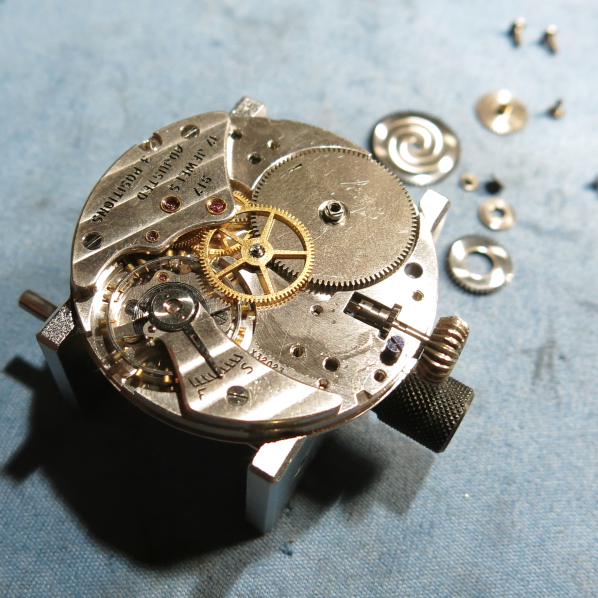
Next off is the train bridge and now all the wheels are exposed and can be safely removed. The balance assembly comes of next.
With the balance assembly out of the way, the pallet fork is the only thing remaining on this side of the movement. Two screws will free the bridge and it can come out.
The various cap jewels are removed to ensure the balance jewels get cleaned. There are only two cap jewels in this movement - one on each side of the balance.
While everything is being cleaned, I'll turn my attention to replacing the mainspring. Pocket watch mainsprings can really pack a wallop so you have to be careful when installing them.
Everything gets cleaned, oiled and put back in it's proper place.
And with a little tweaking to the regulator, the now running movement is running very well with good amplitude, a low beat error and just a few seconds fast per day.
For this conversion I decided to install the movement in a PVD case. PVD stands for Physical Vapor Deposition and it's a coating that adds a very fine layer of black to the base stainless steel case. Unlike paint or enamel, PVD won't flake off. It's pretty tough but can be scratched or even polished through.
Paired with a woven carbon fiber strap and with the blued spade hands, this a really sharp looking watch.
The case features gaskets around the screw-down crown as well as under the screw down display back. I love the display back. It's great to be able to see the movement happily ticking away 5 times per second.
At 45mm wide, this watch has a significant wrist presence. It's still smaller than some of the glamor watches you see people wear today. To me, this is a large watch but not so large that I feel like I have a tuna can on my wrist.
Information about vintage Hamilton watch repair, restoration, models, and advice for collecting and collectors
Welcome
Greetings!
Sunday, February 9, 2014
Saturday, February 8, 2014
1963 Gregory
It's rare, thankfully, that I buy a "pig in a poke" but it does occasionally happen. I recently purchased a watch that I thought was one model, but turned out to be another - the real issue though was the disaster behind the dial. Before I tell you that story though, let me tell you first about the model.
The 1963 Gregory was the second model to bear the name, the earlier version was released in 1954. Like the original, the 1963 Gregory was produced for only two years.
The Gregory comes in a yellow rolled gold plate case with a stainless steel back. The dial has a pearlescent white finish with embossed yellow numerals and markers. It was available on a bracelet or a leather strap.
Behind the dial you'll find Hamilton's Swiss-made 17 jewel 686 movement.
So onto my project watch. As it arrived it was non-running and listed for sale as needing a mainspring - I thought, "no problem, I can handle that".
Removed from behind the crystal, the dial and hands are very nice.
The other side of the dial is another story all together. There's a ton of rust on the stem side and the hairspring is a tangled disaster… maybe the seller thought that was a mainspring?
You can see the hairspring better in this shot… I think it might have a few issues... in fact, it's a total loss.
The extensive rust and the destroyed balance were probably grounds for returning the watch but since the rest of the case, dial, etc is decent I decided to keep it. I happened to have a spare 686 movement to drop in it's place.
My spare movement has a broken second hand pivot - it should extend below the 4th wheel arbor in the shot below but it's not there. So I'll just use the 4th wheel from the damaged movement.
Well, cleaning the movement and a good 4th wheel got my donor movement back into working order but it started out running a little more than 3 minutes fast per day with a high beat error.
Tweaking the regulator slows it down but I still have a high beat error.
The 686 has a moveable hairspring stud so I can adjust the beat error with the balance in place and running on the timer. Notice how the two lines get closer and closer to each other, indicating the beat error is being reduced.
I'll settle for running right on time with 0.2ms beat error and nice amplitude. Mission accomplished.
My original movement had a rusted out stem so I need to fit a new stem and crown for the donor movement. Fitting a stem means cutting it to the proper length. You don't want to goof that up!
And here's the finished Gregory, all polished up, running great and outfitted with a new black lizard strap.
The 1963 Gregory was the second model to bear the name, the earlier version was released in 1954. Like the original, the 1963 Gregory was produced for only two years.
The Gregory comes in a yellow rolled gold plate case with a stainless steel back. The dial has a pearlescent white finish with embossed yellow numerals and markers. It was available on a bracelet or a leather strap.
Behind the dial you'll find Hamilton's Swiss-made 17 jewel 686 movement.
So onto my project watch. As it arrived it was non-running and listed for sale as needing a mainspring - I thought, "no problem, I can handle that".
Removed from behind the crystal, the dial and hands are very nice.
The other side of the dial is another story all together. There's a ton of rust on the stem side and the hairspring is a tangled disaster… maybe the seller thought that was a mainspring?
You can see the hairspring better in this shot… I think it might have a few issues... in fact, it's a total loss.
The extensive rust and the destroyed balance were probably grounds for returning the watch but since the rest of the case, dial, etc is decent I decided to keep it. I happened to have a spare 686 movement to drop in it's place.
My spare movement has a broken second hand pivot - it should extend below the 4th wheel arbor in the shot below but it's not there. So I'll just use the 4th wheel from the damaged movement.
Well, cleaning the movement and a good 4th wheel got my donor movement back into working order but it started out running a little more than 3 minutes fast per day with a high beat error.
Tweaking the regulator slows it down but I still have a high beat error.
The 686 has a moveable hairspring stud so I can adjust the beat error with the balance in place and running on the timer. Notice how the two lines get closer and closer to each other, indicating the beat error is being reduced.
I'll settle for running right on time with 0.2ms beat error and nice amplitude. Mission accomplished.
My original movement had a rusted out stem so I need to fit a new stem and crown for the donor movement. Fitting a stem means cutting it to the proper length. You don't want to goof that up!
And here's the finished Gregory, all polished up, running great and outfitted with a new black lizard strap.
Thursday, February 6, 2014
1955 Automatic K-503
I've been on a roll lately with 1950's Automatics, so why stop now?
In 1955 Hamilton added 7 more models to the automatic lineup, including a couple of 18K models in the line K-100 line. 14K models were in the K-200. 10K models are 300 and gold filled are 400 series models. Stainless steel models were given names in the 500 series.
One of the 1955 introductions was the Automatic K-503. It was produced for a long time (at least by Hamilton standards) - all the way until 1960. There are no serial numbers inside the watches to date the year a K-503 was produced, but slight changes to the dials occurred over the years so you could actually collect four different varieties of K-503.
In the 1956 catalog there were black and white versions of the K-503. In 1955, only the white version was available. Note the direction and size of the triangular hour markers, they both point outward but the black version's are smaller.
In 1957 there were still black and white dials but the hour markers changed slightly.
In 1958 the white dial changed back into larger hour markers, but the direction was changed to inward. Plus the shape of the numbers changed as well as their orientation around the dial.
And in 1960, only the white dialed version was available.
Who'd have thought that one model could have so many subtle changes to the dial?
Behind the dials you'll find Hamilton's 661 movement. It was used predominantly in the K-series watches. When the Accumatics, Thino-matics, Kinematics and Rotomatics were introduced, so were new movements.
I recently picked up a nice black dialed K-503 so it's probably from the 1956 - 1959 period. I almost bought a white dialed version too - but the dial was different and I (wrongly) thought it was a franken so I passed on it. I know better now - and so do you.
My black-dialed version is definitely in need of a new crystal and an overhaul.
The screw-off case back is clearly marked K-503.
The 661 movement is fairly clean looking but I don't know it's history so I'll make sure it's got fresh oil by giving it an overhaul.
Pretty good time keeping fresh out of the gate. Vintage watches can often keep excellent time but I think a range of +/- 30 seconds per day is a well running watch. +/- 1 minute per day is fair too - beyond that a little tweaking or an overhaul is probably warranted.
Here's the movement all cleaned up. I find the difference between a cleaned movement and a dirty movement to be visually very satisfying. When it runs as well as it looks, it doesn't get better than that!
And here it is all polished up with a new crystal, new strap and fresh lume applied to the hands and the dial hour markers.
The K-503 is a great looking watch and I can see why it was produced for 6 years.
UPDATE - DEC 17, 2014
Here's a 1957 white dialed K-503 I restored, a sibling to the black dialed version above.
Before...
... and after a thorough cleaning, resuming the hands and dial, a new crystal and a nice lizard grain strap.
In 1955 Hamilton added 7 more models to the automatic lineup, including a couple of 18K models in the line K-100 line. 14K models were in the K-200. 10K models are 300 and gold filled are 400 series models. Stainless steel models were given names in the 500 series.
One of the 1955 introductions was the Automatic K-503. It was produced for a long time (at least by Hamilton standards) - all the way until 1960. There are no serial numbers inside the watches to date the year a K-503 was produced, but slight changes to the dials occurred over the years so you could actually collect four different varieties of K-503.
In the 1956 catalog there were black and white versions of the K-503. In 1955, only the white version was available. Note the direction and size of the triangular hour markers, they both point outward but the black version's are smaller.
In 1957 there were still black and white dials but the hour markers changed slightly.
In 1958 the white dial changed back into larger hour markers, but the direction was changed to inward. Plus the shape of the numbers changed as well as their orientation around the dial.
And in 1960, only the white dialed version was available.
Who'd have thought that one model could have so many subtle changes to the dial?
Behind the dials you'll find Hamilton's 661 movement. It was used predominantly in the K-series watches. When the Accumatics, Thino-matics, Kinematics and Rotomatics were introduced, so were new movements.
I recently picked up a nice black dialed K-503 so it's probably from the 1956 - 1959 period. I almost bought a white dialed version too - but the dial was different and I (wrongly) thought it was a franken so I passed on it. I know better now - and so do you.
My black-dialed version is definitely in need of a new crystal and an overhaul.
The screw-off case back is clearly marked K-503.
Pretty good time keeping fresh out of the gate. Vintage watches can often keep excellent time but I think a range of +/- 30 seconds per day is a well running watch. +/- 1 minute per day is fair too - beyond that a little tweaking or an overhaul is probably warranted.
Here's the movement all cleaned up. I find the difference between a cleaned movement and a dirty movement to be visually very satisfying. When it runs as well as it looks, it doesn't get better than that!
And here it is all polished up with a new crystal, new strap and fresh lume applied to the hands and the dial hour markers.
The K-503 is a great looking watch and I can see why it was produced for 6 years.
UPDATE - DEC 17, 2014
Here's a 1957 white dialed K-503 I restored, a sibling to the black dialed version above.
Before...
Subscribe to:
Posts (Atom)


