Welcome


Greetings!

Thanks for visiting my vintage Hamilton watch blog. I like to restore US-made Hamilton wrist watches back to their original glory and share my experiences with other enthusiasts. Use the "Search" space below if you know what model you're looking for. Feel free to leave polite comments or questions in the spaces provided. Also check out my "watches for sale" on my Etsy site - the link is on the right, just below.

Monday, June 20, 2022

1911 Hamilton 974L Pocket Watch

My first love, when it comes to Hamilton watches, was pocket watches.  Like most collectors, my first introduction to vintage watches was by inheriting some pieces from my grandfather.  Some were my great grandfather's, in fact.  All of them were pocket watches and the best of which was a Hamilton 992B railroad watch.  My grandfather worked for a railroad for a while, as well as a prison guard and a shopkeeper.  Watches make great heirlooms and I think of my grandfather's life every time I wind his watch. 

I recently was contacted by someone who's prized Hamilton pocket watch was damaged when one of his kids played with it a little too roughly.  It's over 110 years old and is a lever set 974 pocket watch from 1911.

The 974 is an entry level 16 size model at it was made for 20+ years.  It evolved over time and although the main elements stayed the same, there are some important elements that varied.  One variable is the 974 came in lever set as well as negative set variants.  Level set was important because the watch couldn't accidentally pop into the time setting position the way a negative set movement can.  I'll point out some of the other unique features below.

As received, the watch appears to be in excellent shape overall.  It shows some wear over the last 110 yeas but it's definitely not worn out.


The back cover is nicely engrave with a bird and floral design.


The movement is complete and with a slight shake I was able to get it to tick - that's a good sign.  Notice the crown wheel is held down with two screws.  On later versions a single reverse thread screw would be used.  A reverse thread screw is opposite a normal screw so instead of "lefty loosey" it's "righty loosey" and you turn it the opposite direction to remove it (or you break it by over-tightening).  The two screw design is more easily removed.


I don't normally check the timing of watches before I work on them but in this case I wanted to see what I was in for.  I gave the watch a few winds, got it running, and put it on the timer to see what it looked like.  It's running slow but that because I didn't wind it very much.  The beat error of 9.4 ms means the balance is out of alignment, that could have happened when it got banged by the owner's kids.  In fact, it may have gotten "over-banked", where the balance impulse jewel gets on the wrong side of the pallet fork and stops the watch.


Here's another unique feature of an early Hamilton pocket watch.  The dial has four dial feet... in a few years that would change to three feet so replacing dials on old pocket watches requires you to know how many feet are involved.  Getting a dial from a later 974 wouldn't work for this watch.


A lever set movement has a lever that you slide out (at the 1:00 position) to move the keyless works into the time setting position.  A negative set movement would have a couple extra springs under the dial and require a different case design as well.  I like lever set movements, they are less troublesome.


I noticed some little gold flecks under the dial and after looking closely I can see the minute wheel is missing a bunch of teeth on the inner pinion.


I also saw the hour wheel (that engages the minute wheel) is missing a tooth or two.  I found a few more tooth pieces as I went along.  This would definitely stop a watch or cause the minute hand to move while the hour hand didn't.


I was happy to see a white alloy mainspring is already installed.  That's one less thing for me to deal with.


I have to look closely at the balance wheel from this angle to try to identify which side the balance is off by.  The photo didn't capture it but I could see the impulse jewel was off to the right.  I can adjust that later.


With the balance removed you can see the blue hairspring stud is just above the arm on the left, I'll rotate the hairspring counter clockwise a smidgeon to adjust the position of the impulse jewel relative to the hairspring stud.  Confused yet?  It takes a while to grasp the concept but in a nutshell the only two parts of the balance that are fixed in position are the hairspring stud (attached the balance cock) and the impulse jewel that engages the pallet fork.  The position of the stud relative to the impulse jewel determines how centered the impulse jewel is.


I'll pull a "new" minute wheel and hour wheel from a donor movement and clean them with the other parts.
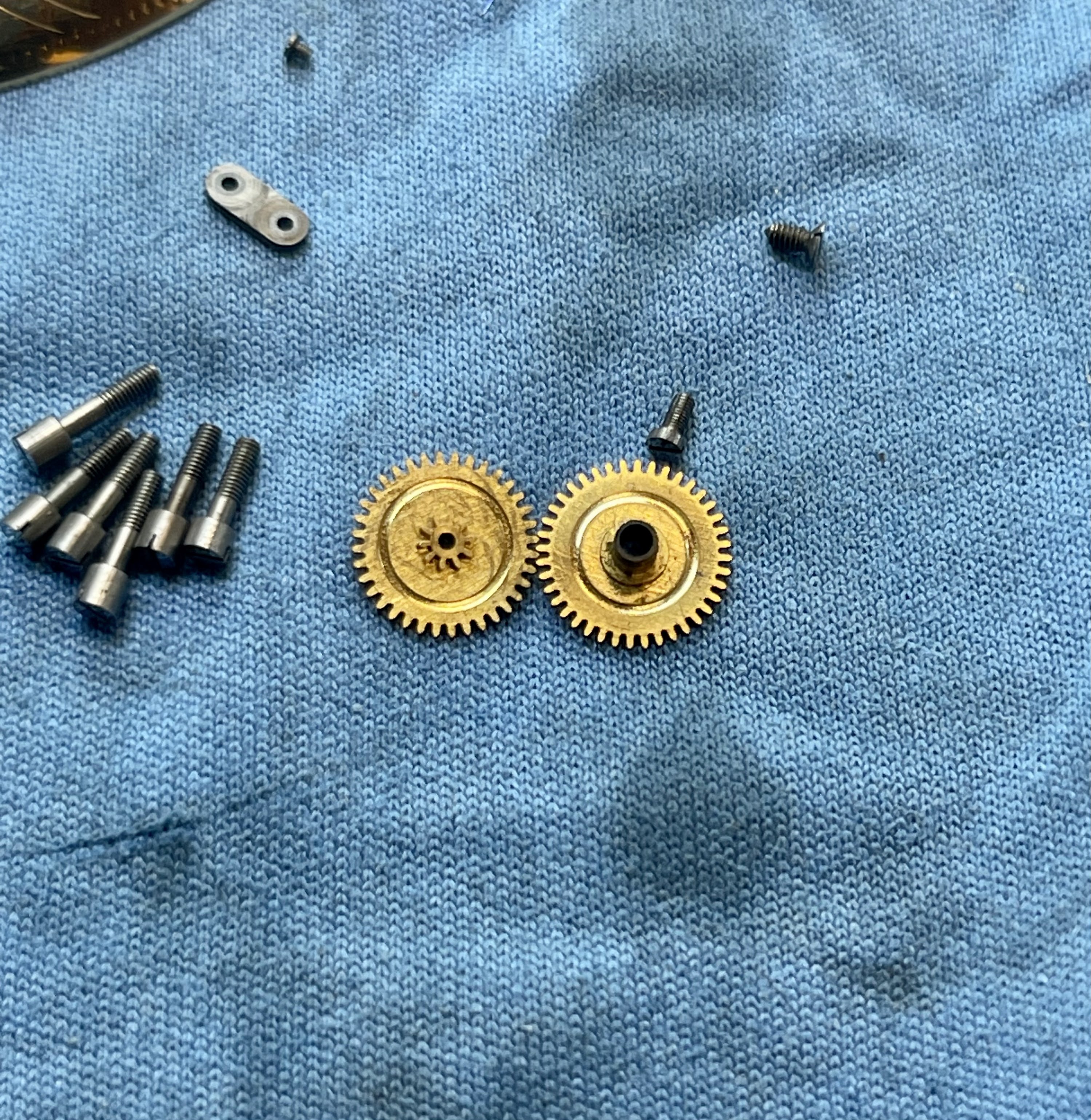

Everything is cleaned and dried before being reassembled.  Pocket watches have about the same number of parts as wrist watches but they are much bigger and take up a lot of room when they are laid out.


The movement is reassembled and I gave the balance my best guess in terms of adjustment.  I'll have to install it to see how I did.


Well, the beat error is reduced to 3.5 ms but that's still a bit too high so I will give it another go.  I'd like to get it under 1.0 if I can.


There... that's much better. 0.7ms is good enough.  0.0 would be ideal but you're talking about a very small adjustment and every attempt risks goofing up the balance.  I've learned the hard way that good is usually good enough.


The replacement minute wheel and hour wheel are in place and look just as they should.  Cannon pinion holds the minute hand and the cannon pinion turns the minute wheel which turns the hour wheel that holds the hour hand.  These two parts are what keep the two hands synchronized.


The reassembled movement is installed back in the case and is ready to go home to its owner.  Hopefully it will be safely hidden from little fingers but still enjoyed as a treasured timekeeper until it can be passed down to the next generation.

Monday, May 30, 2022

1956 Parker B

Hamilton often introduced movement changes during a specific model's run that required a slightly different case design.  These models were typically given a B designation.  This became very common when the 14/0 sized 980, 982, and 982M movements were replaced by the 12/0 size 752, 753 and 754, respectively.

The another wave of B models came out in 1955 / 56 when the 770 movement was introduced.  The 770 is a 12/0 size movement and would fit into a case for a 752, 753 or 754 without being a B model.  However, there are a few examples where a 770 replaced the 8/0 sized 747 movement.  That was the situation for the 1954 Parker when it became the 1956 Parker B.  

You might wonder why Hamilton didn't just move to the shock jeweled 730 movement when it replaced the 747.  I wonder that too - although the 770 was the pride of the Hamilton movement lineup.

The Parker B continued to be produced into 1961 so it's not a difficult model to find in the wild.  The case is solid 10K gold though, so I'm sure more than a few have made their way to be melted when someone decided to turn a $350 watch into $100 cash.

My project Parker B came to me in well-loved condition.  It's obviously had some miles put on it but it's not overall in terrible shape.  The second hand is an obvious replacement and the crown is too.

The crown is called a "stone crown" and has a jewel of some sort embedded.  Hamilton didn't use a lot of stone crowns on men's models but I have seen it before on new old stock models like the Liberty Coin.

With the bezel and crystal out of the way you can see the dial is pretty rough.  This sort of dial rash is common when a watch loses it's crystal but this one was intact so maybe there is some sort of other environmental reason for the toning and scratches.

Up until this point I wasn't sure if I was dealing with a Parker or a Parker B.  The Parker with the 747 movement is much less common.  Once I got the movement out of the case it was immediately identifiable as a Parker B.  

The inside of the case back is specifically formed to accommodate a 12/0 movement.  The 747 is round and would have a differently-shaped cutout.

The crystal is due to be replaced and a quick measurement shows that a 29.2mm diameter high dome crystal will do nicely.

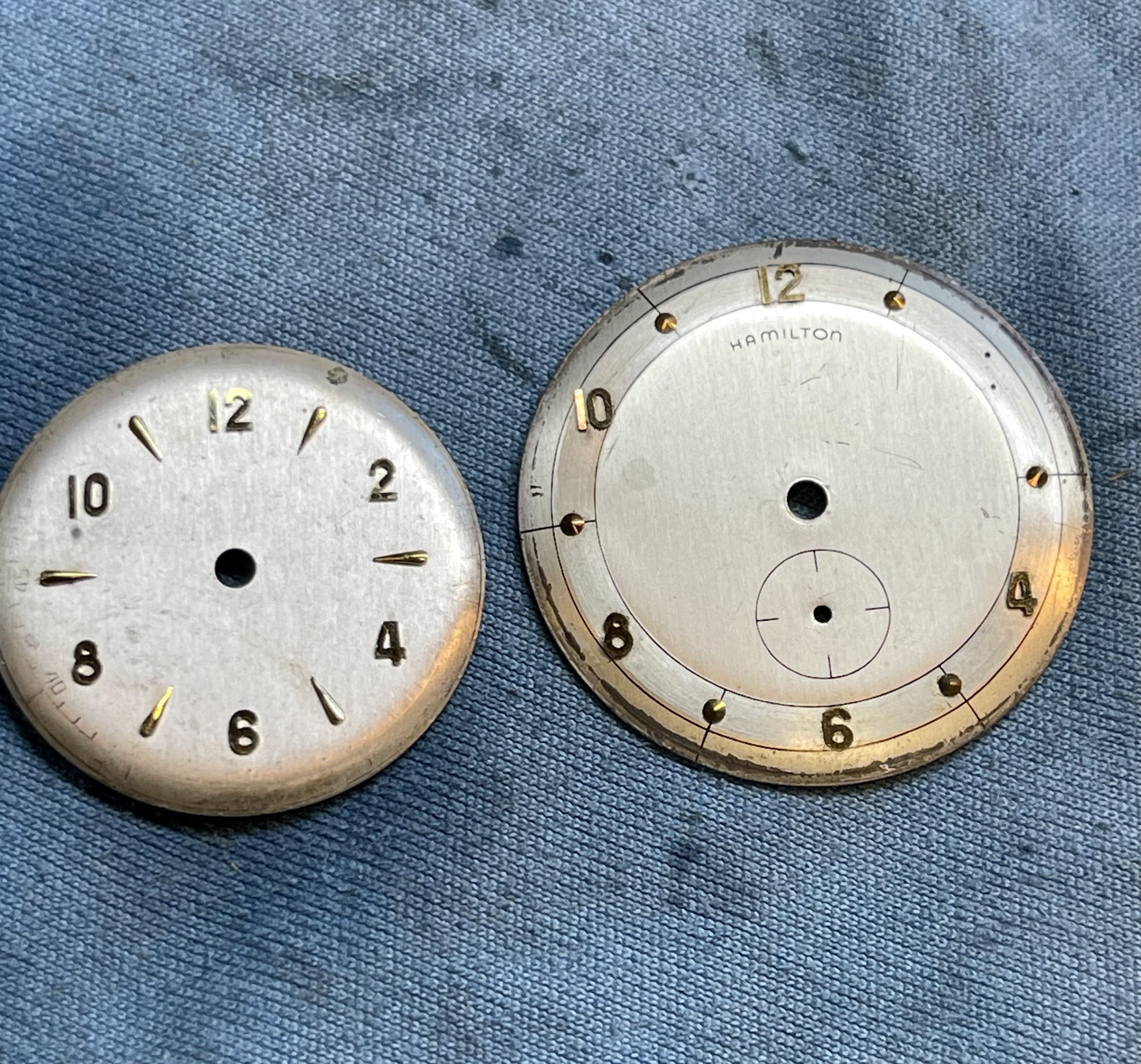
Looking in my stash of dials, I happen to have a Parker dial.  The position of the dial feet are different on a Parker vs Parker B so I'll have to verify that it's the correct dial.  Looking closely I noticed the number 2 was missing so if this is the correct style dial, I'll have to replace that marker.

It is the correct dial so now I need to find a proper number 2.  A donor dial from a Nordon will do the trick.  Markers are actually riveted on so you can carefully remove them from one dial and apply them to another as long as the markers are the same.

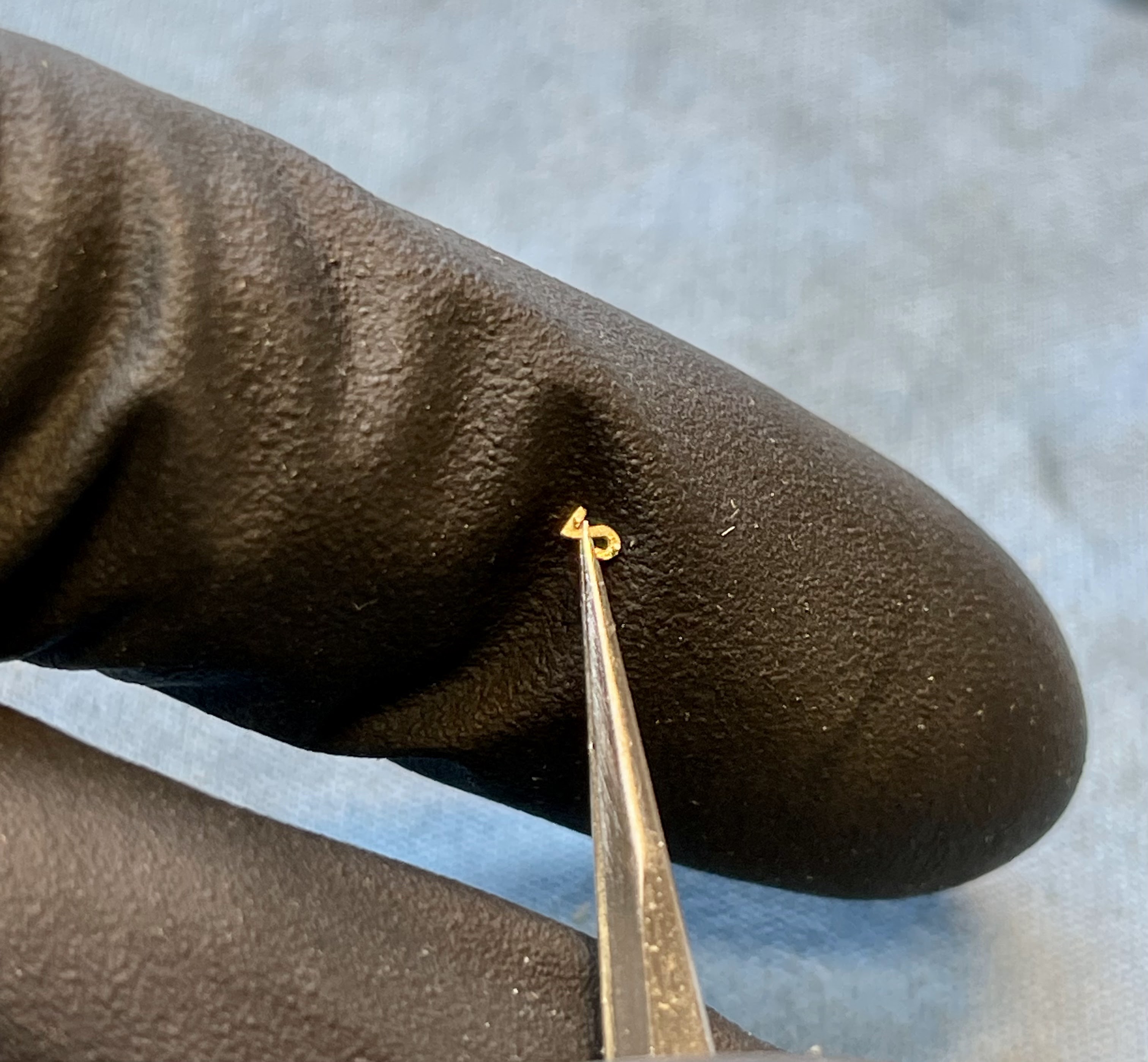
If you look closely at the number 2 you will see the two posts that will go into the holes in the dial.  I usually apply a little UV glue to the back of the dial to make sure the rivets hold - then put the dial under a UV lamp.

There - good as new.

Everything is take apart and thoroughly cleaned and dried.  Now I can reassemble everything with fresh lubricants in all the right places.

The reassembled movement is ticking away with good motion.  Time to see what the timer thinks.

Running a smidgeon slow and the beat error is a little high.  A slight tweak to the regulator will speed the balance up.  I'll leave the beat error as is.  My personal spec for beat error is 3.0ms.  Above that I will try to reduce it.  Below that the risk to the balance outweighs the benefit of a lower beat error.  

Adjusting the beat error requires removing the balance from the balance cock and adjusting the position of the hairspring over and over until you get it right - each time is a roll of the dice that tempts doom.

Beat error represents how centered the balance is by swinging one side to the other.  If the beat error is zero the balance swings equally one side to the other.  A watch with a slightly higher beat error will stop sooner than a watch with no beat error.  Whether a watch stops after 39 hours or 40 hours is pretty inconsequential when it comes to a vintage watch.


It doesn't take much adjusting to get the beat rate up to slightly fast at 14 sec/day.  I'll leave it there as watches usually settle down after a while.

The finished watch now looks as good as it runs and it runs great.  The metal bracelet is not original but it doesn't have spring-loaded ends and it looks good with the watch so I'll leave it as is.


Sunday, May 22, 2022

1961 Sherwood R

 Based on feedback from my last post, folks don't mind seeing blog updates of interesting models, even if they've been documented before.  So here's another cool watch to show you.

It's a 1961 Sherwood R.  Although it was made for two years, you don't come across Sherwood models too ofter.  

There are several Sherwood models from 1961 and 1962 and what makes them interesting is they feature wooden dials. Actually the dial is a blend of a wood veneer on a metal substrate.  The wood is so thin that it was very problematic to meet Hamilton's quality standards and they dropped the concept after 1962.

The Sherwood R can in a solid 14K gold case and featured American walnut.


You could get the Sherwood R in white gold or yellow, although I can't say I've ever seen a white one.  It came originally on an alligator (or croc) strap.  If the case looks familiar, it's because it's identical to the Sir Echo that produced at the same time.

My project watch is only the second example I've seen.  It arrived in typical "as found in a dresser drawer" condition... a bit beat up and sans strap.


The case is a two piece design with the bezel and lugs on one side and the back on the other.  The movement, dial and movement ring are sandwiched in between.


Looking closely at the lugs you can see that this watch spent many years paired with a metal bracelet and the bracelet ends have worn grooves into the already delicate lugs.  This could be repaired by a goldsmith but it's not too bad yet. 


There is nothing I will do to this dial - it is what it is.  Anything I would attempt would likely result in dismal failure so this is definitely a "let sleeping dogs lie" situation.


The 22 jewel 770 movement is tucked inside a movement ring and it's in there TIGHT.  It took a while to get the movement out because I didn't want to try to lift it out using the backside of the dial.  Patience goes a long way in these situations and eventually the movement ring gave way.


The crystal is very beat up, yellowed, and probably the wrong size as it was glued into the bezel.

 
A new crystal will go a long way toward improving this looks of this watch.


Everything is taken apart and fully cleaned before being reassembled with fresh lubricants.


The reassembled movement is ticking away with a good motion, time to see what the watch timer thinks.


Not too shabby.  The beat error of 1.0ms is well within my personal specs of 3.0ms.  It's very challenging to reduce it from here as each attempt risks making it worse or damaging the hairspring.


Paired with a new black leather strap, this 1961 Sherwood R now looks fantastic and it runs as good as it looks.