Welcome


Greetings!

Thanks for visiting my vintage Hamilton watch blog. I like to restore US-made Hamilton wrist watches back to their original glory and share my experiences with other enthusiasts. Use the "Search" space below if you know what model you're looking for. Feel free to leave polite comments or questions in the spaces provided. Also check out my "watches for sale" on my Etsy site - the link is on the right, just below.

Monday, September 5, 2022

1928 Illinois Ritz

 In 1928 Hamilton Watch Company purchased the Illinois Watch Company and... then the Great Depression happened.  Within a few years the Illinois Watch Company was no-more and whatever could be salvaged was moved to Lancaster, PA.

The Illinois Watch Company was a well known American manufacturer with a great line up of wrist and pocket watches.  It was a great opportunity to expand Hamilton's business, gain economies of scale, and benefit from the technological synergies that Illinois offered.

Shortly after the acquisition, Hamilton introduced their Explorer series with Hamilton-branded movements based on Illinois designs.

Illinois continued to make watches for a while and one of them was the Illinois Ritz.  The Ritz is a unique model in that it was offered in a two-tone white & yellow case - a very popular option.


I don't know that much about Illinois watches, to be honest.  However there is an excellent set of books available from Fred Frieberg at www.illinoiswatches.com.  

I find Illinois watches to be as good as Hamilton watches from the 1920s but that simply means they can be VERY finicky and lack the technological improvements that came later in the 1930s and beyond.  I'm sure in 1930 they were excellent watches and with a watchmaker in every jewelry store they were easy to repair when necessary.  However, fast forward 90 years and you'll likely find Illinois watches with a LOT of mileage that are long overdue for maintenance.  Good luck finding spare parts! 

They can be very tempting though and Illinois models can offer really, really cool designs.  My latest project is a good example. 

Looking at the watch, in color you can see the impact of a two-tone case.  The dial is obviously refinished and the hour and minute hands are the incorrect style but only a purist would care.


The case back is also white gold filled and snaps on and off.


Opening the back of the watch, I can see it's been serviced fairly recently but you never know what the codes inside indicate.  Watchmakers have different methods for marking watches they've worked on.  

One thing I can tell for sure is this watch is missing the case screws that secure the movement inside the case.  Based on the dull brass color of the jewel settings, I'd say it's been a few years since this watch was last cleaned so the 1-11-17 could be from January 2017.  Five years is definitely due for another cleaning as the oil inside eventually evaporates.


Everything is cleaned and dried.  This watch already had a white alloy mainspring installed, another sign that it had been overhauled sometime since 1950 or so.


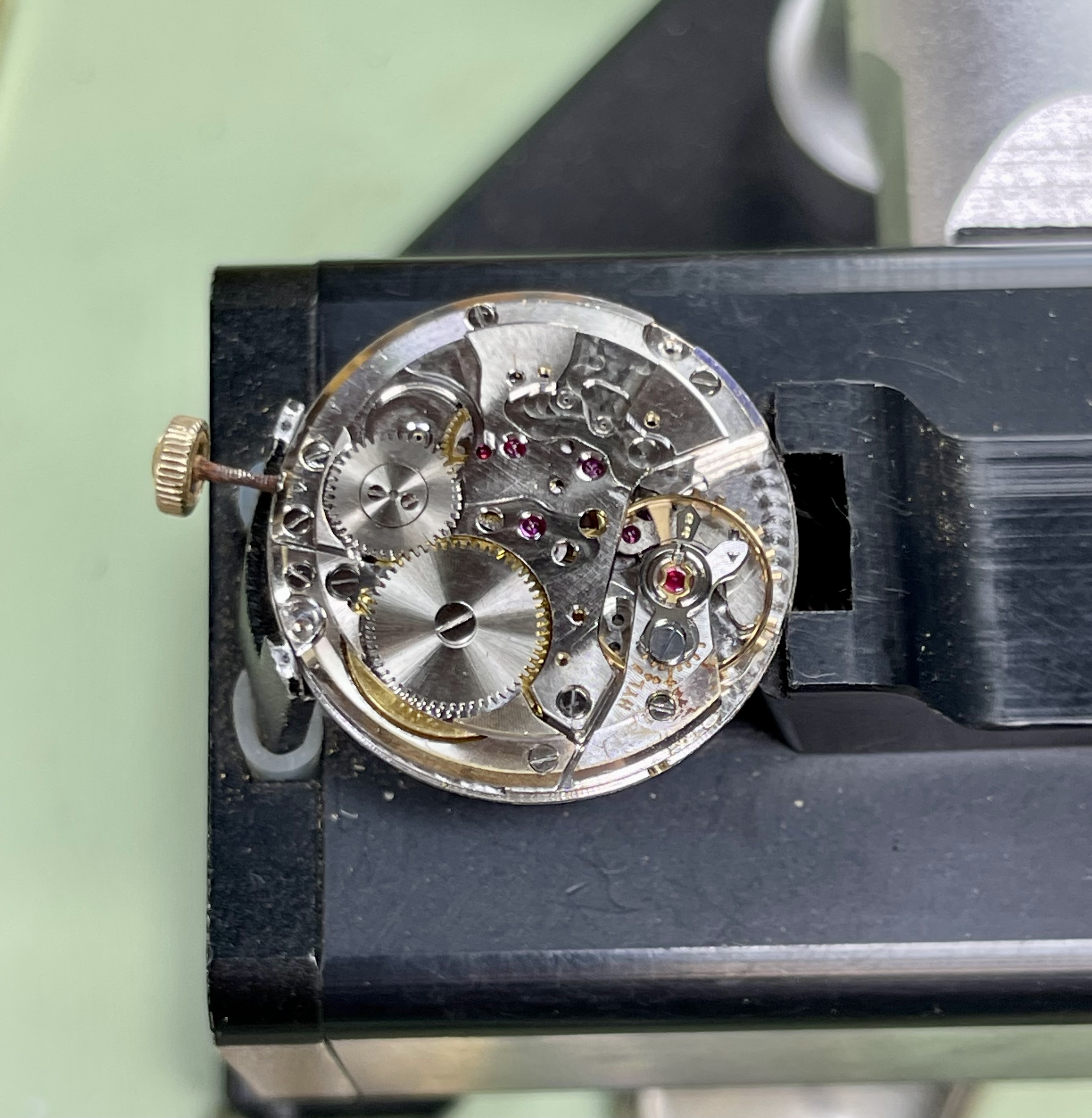
Dang... it took me about 90 minutes to get this movement working again.  Did I mention I find these old movements finicky?  Power wouldn't transfer through the gear train very well.  I think the 3rd wheel had too much end shake and it would wobble.  I had to finally adjust the jewels so that they were closer together and would support both ends of the 3rd wheel pivots.  Finally I got it run with good motion.   Notice how much brighter the movement is overall and especially the brass jewel settings - that's a sign of freshly serviced movement.  A good clue to look for when looking at "serviced" watches on ebay.


On snap!  This watch is running very slow.  I didn't wind it too much so the low amplitude is partly due to that but the beat rate is really slow.


A lot of things can make a watch run too fast but too slow is a possible indicator that the regulator isn't holding the hairspring.  Without a regulator the hair spring is too long and that makes the watch run slow.  Looking closely at the regulator, I only see one prong where there should be two.


Here's an even closer look... I only see one prong where there should be two and the hair spring should be in between.  Note the two gold circles on the regulator and only one has something below it.  The "fork" holds the hair spring enough to effectively shorten the hairspring and make the balance spin faster.  With only one prong, there's not much holding the hairspring.


Moving the regulator closer to fast speeds up the watch a little but it's still running around 5 minutes slow per day.  That's not great but not too many people from 1928 are doing as well.  Considering a vintage watch is only worn for a few hours a day, most collectors would tolerate this performance and just set the time a little ahead in the morning so it catches up later.  There's not much I can do about it anyway - I don't have any spare parts for Illinois movements.


My finished project is looking great and it has fresh oil in it so it can be enjoyed, even if it will be a little slow over 24 hours.  Such is the life of a 90 year old watch.

Sunday, September 4, 2022

1980s LL Bean Field Watch

 I have a couple of new models to eventually post that I haven't done before but I thought I'd share another previously documented model first.

This is a LL Bean Field Watch made by Hamilton during the 1980s.  It's essentially the same as the Khaki model and you'll find other branded examples by Orvis and Brookstone.  I like these watches and I've collected quite a few over the years.  They are based on the US military watches made at the same time.  

These watches are very popular - so popular, in fact, that Hamilton continues to make more modern versions of these watches, except they are a little larger today.


My latest project arrived with a broken crystal but is otherwise in good shape.  It will look a lot better with some fresh luminous paint on the hands.  The catalog image shows you what it would have looked like originally.


All of these field watches have the same model number - 921980.  Later Khakis from the 1990s have a different model number 9415A.  They are similar but actually have an even better movement inside.  

One thing interesting about this example is the case back is a little different than other LL Beans I've restored. 


The inside of the case back is also engraved differently than other models I've seen.  It says the same thing, just in different places.  What's really unusual is this movement doesn't say Hamilton or 649 on it.  It's the correct caliber, etc. so I don't think there's anything suspicious about it - it's just interesting. 


I'll align the hands so they are easier to remove.


West Germany united with East Germany in October, 1990 - so based on the back of the dial this watch is clearly earlier than that


Everything is completely disassembled and thoroughly cleaned.  The best part of this movement is you can mess up which screw goes where - they are all the same!  Everything is bright and shiny.  Now to put it back together with fresh lubrication.


As for a new crystal, this model features a reflector ring but it's parkerized like the case.  I'll use Stella WRA crystal in 28.5mm and reuse the original ring.


The trickiest part of reassembling the movement is to remember to reinstall the L-shaped lever used to "hack" or stop the watch when you set the time.  This little golden level engages the clutch and is moved over to touch the balance when the clutch is moved to the setting position.


The reassembled movement goes onto the timer and although the beat rate is great, the beat error is a little high.  It's so easy to adjust that trying to get it closer to 0.0 is a no brainer.


There... 0.3ms is more than acceptable.


As promised, the finished watch looks fantastic with a new crystal and freshly re-lumed hands.  This watch is definitely ready for some more wrist time.

Saturday, September 3, 2022

1955 Automatic K-402

 The "worst" watch I've ever come across was found on a beach on the Pacific coast.  All that was left was the dial and I could tell from the markers that it was from a Norman.

I recently came across a contender.  It also took a swim in the Pacific about 30 years ago.  The owner kept the watch but never had it addressed.  That is, until recently when he sent it to me to see if I could salvage it.

The model is a 1955 K-402.  It was made through 1957,


Looking at my project watch, there's a halo of rust around the crystal as well as on the dial.  To be honest, I wasn't really sure what I was going to find inside.


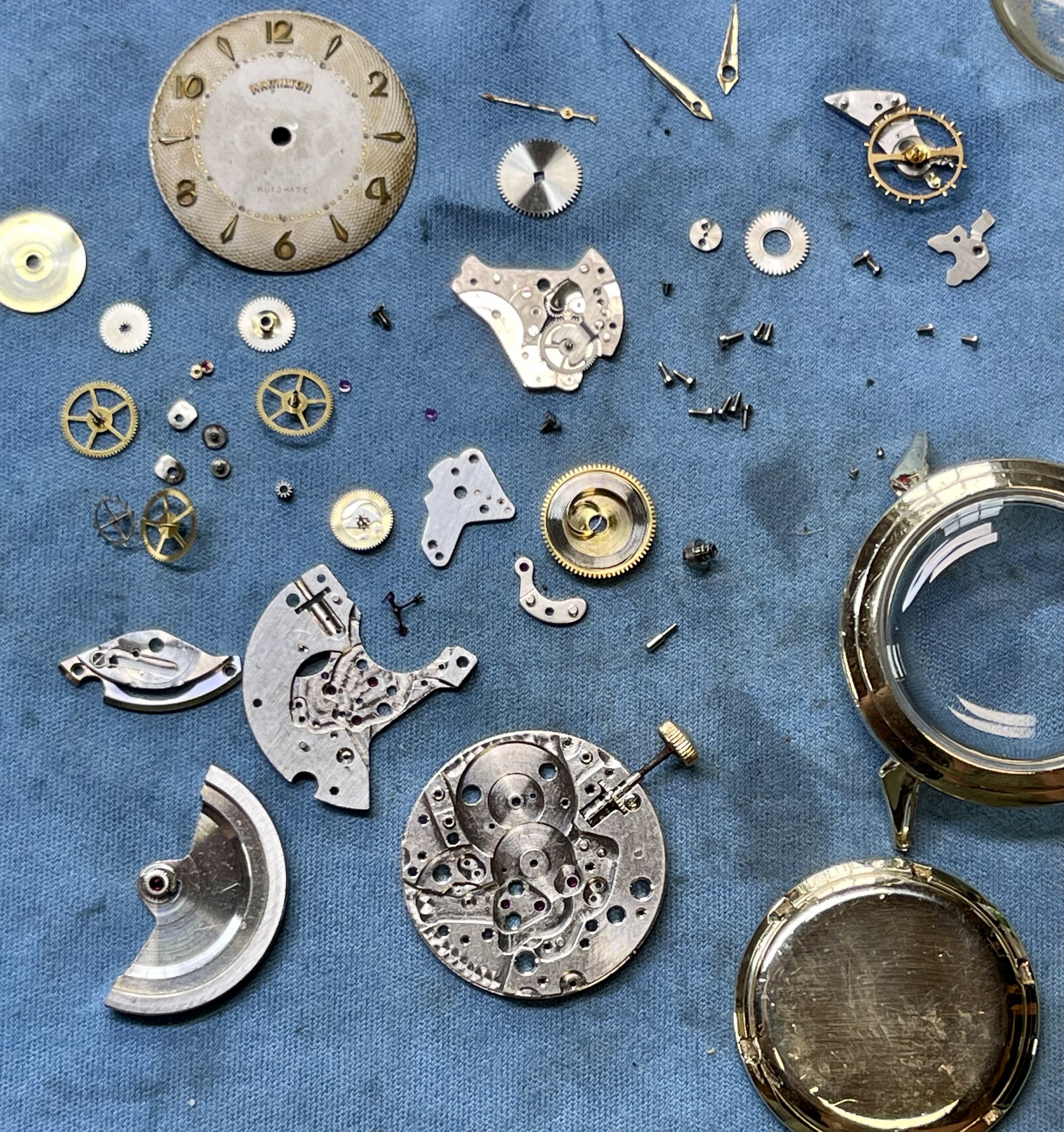
I was able to get the case back off and revealed the rustiest 661 movement I've ever seen.  The rotor was seized and there's really nothing inside that appears serviceable.  This is really a less for all watch owners - if you get water inside, especially salt water, make sure you get the watch dried and serviced as soon as possible.

The first trick will be to get the movement out of the case.


Success!  I was able to get the movement out and I was also able to get the dial off without breaking the dial feet off the dial.


The movement is held inside the case by a couple of case clamps.  I should be able to reuse them.


The inside of the case back makes identifying the model very easy - K402 is stamped right inside the back.


From this point I will have to proceed with a donor movement.  The crown on the rusty stem is from a Wittnauer watch so I'll replace that too.


My donor 661 movement is completely disassembled, cleaned, and ready to be reassembled.  I was able to clean the dial fairly well but it's not perfect.  It will be a reminder to keep this watch away from the water in the future.


The reassembled movement is ticking away with good motion.  Now it's off to the timer to see how it sounds.


Not too shabby.  I will tweak the regulator and speed it up slightly.


A couple of very minor adjustments gets the beat rate running just slightly fast at 11 seconds fast per day.


The automatic framework and rotor are reattached and swinging freely - now it goes back into the case.


Well, I have to say that this watch turned out a lot better than I thought it was going to.  The dial cleaned up nicely and with the hands relumed along with a new crystal, it looks great, considering all that it's been through.