Welcome


Greetings!

Thanks for visiting my vintage Hamilton watch blog. I like to restore US-made Hamilton wrist watches back to their original glory and share my experiences with other enthusiasts. Use the "Search" space below if you know what model you're looking for. Feel free to leave polite comments or questions in the spaces provided. Also check out my "watches for sale" on my Etsy site - the link is on the right, just below.

Sunday, September 11, 2016

1959 Valiant

Some of the most popular Hamilton models are the asymmetric models.  They're called that because the cases have unusual shapes.   Although they may be symmetrical in one axis, they look imbalanced in another.  The tops may be different than the bottoms or the left side may not be the mirror of the right side.  Asymmetric models were made with Electric, manual wind and even automatic movements.

Although the genre is typically thought of as being 1950's and '60's creation, the first asymmetric was actually produced in 1930 with model called the Spur.   You might also recall the 1938 Brooke.  However, most asymmetric models are from the 1950's and '60s.

One of the mechanical models is the 1959 Valiant.  It was produced for four years and it was also paired with a woman's model called the Vala as a "his and hers" set.


The Valiant came in a yellow 10K gold filed case with a sterling silver dial and 14K markers and numerals.  Tucked inside the case is Hamilton's 22 jewel 770 movement.

I don't think the Valiant is Hamilton's most attractive model.   It has a very odd shape that some folks might think looks cool and that others think is just goofy.   Personally, I wonder if the inspiration for the design and name was the haircut of Prince Valiant?


It's also possible the Valiant was the inspiration for the PacMan ghosts.


Beauty is in the eye of the beholder though and the Valiant surely has a place in the collection of anyone who wants to own all of the asymmetric models.

I recently received a Valiant that is a new addition to a fellow collector.  He wanted to make sure it was properly overhauled before using it.  As received, it's in decent enough shape but has some minor issues.  Let's see how many you can spot?


I don't know about you but I noticed the following...
  • the minute hand is a slightly different style than the hour hand
  • the second hand is too long and could potentially hit the 6 figure
  • the crystal has a slight edge crack by the upper left lug (it's okay if you missed that though, it's hard to see)
  • the dial is an older refinish with so-so printing and an unbalanced seconds cross hair
  • the main issue with the dial is the markers at the 2, 4, 8 and 10 positions are a different style.  They should match the 1, 5, 6 and 11 markers.

None of those are deal breakers but this watch should serve as a good reminder that details like that can be very important to spot, especially in a retail setting where the price tends to be a little higher and watches are typically "rare and all original" when in reality they are neither.

On the plus side, the case is in great shape.  Dials can be redone, hands replaced, and new crystals installed but a damaged case is hard to overcome.  So, overall, this is a nice watch with "good bones".


Based on the slight haze to the movement, I'd say it's been a little while since this watch had a trip to the spa.  It's in good shape though and should clean up well.


The case has a more brassy-look to it than typical Hamilton cases.  The B with a bee logo is the hallmark for Biggs.


If the details on the front of the dial weren't already a clue, the back of the dial has some numerals scratched in to indicate that this dial has been refinished.  You can just barely see them in the photo, but they're hard to see.


Everything is cleaned and dried before being reassembled.


It's always interesting to see the watch's performance pick up when the upper balance shock jewel is reinstalled.  It will run (dial down) without a jewel installed but it's a little wobbly.  Once the upper jewel is installed the watch appears to "kick into high gear" and smoothly accelerate.  It's a great visual sign that all is well.


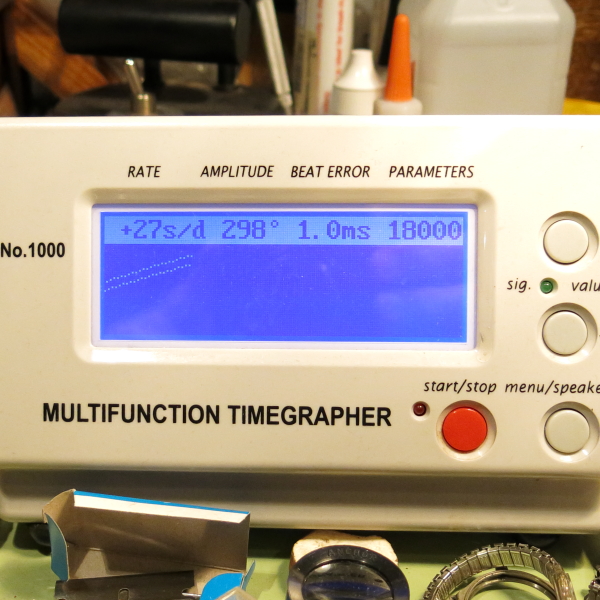
The timer confirms my suspicion that this is a smooth running movement.

My merciless camera and light tent reveal every flaw and even a few that might not even be there.  However, even with that, this Valiant turned out very nice.  The dial could be redone to look like new and I bet replacement markers could be found too.  Other dials probably use the same markers, so you wouldn't have to find a Valiant dial specifically.  The hour hand looks good and only a purist like me would spot the minute hand.  It took some extra care to position the second hand so that it doesn't hit the 6 figure or the hour hand as it swings past.  Replacing the second hand wouldn't be too hard either.


Of course, all of those projects can wait for another day.  This Valiant is ready for some wrist time.

SaveSave
SaveSave
SaveSave
SaveSave

Saturday, September 10, 2016

1940 Midas

There are all sorts of names for Hamilton models.  Originally, watch models were simply identified by their shapes... Cushion, Square, Barrel, etc.  After a few years, new models were introduced and names of famous places or people were used, such as Piping Rock, Coronado or famous explorers like Byrd and Ericsson.  Then more generic names where used - probably after Hamilton employees or associates near Lancaster PA.  Even dress pocket watches were eventually given masculine names.

It really does make you wonder how a model was named by Hamilton designers.  Some names are unique and even exude mystique. Take, for example, the 1940 Midas.  I've heard of King Midas, who could turn things into gold... but have you ever met a person named Midas.  I'm sure there's one or two out there.

The Hamilton Midas was introduced in 1940 and made through 1947.


Also in 1940, Hamilton introduced the Coral Midas... the same model but with a rose gold case.  The coral version was only made for a couple of years.


The Midas is a high end watch, as you might assume from the name.  The case is solid 14K yellow (or rose) gold.  The sterling silver dial has a two tone finish and features solid 18K gold numerals and markers.  The coral version's figure and hands were rhodium plated to appear silver.

The Midas is on the smaller side, even for a vintage watch.  So it would be easily misidentified as a ladies model by someone finding a Midas at a yard sale.

Hamilton also introduced the 982M in 1940.  The M stands for Medallion and the 982M was the 19 jewel 14/0 sized grade that would be used in solid gold cases thereafter.  The 982 grade was previously used in the solid gold models.  After the introduction of the 982M, the 982 would be used in 14K gold filled cases and the 17 jewel 980 dedicated to the 10K gold filled models.

I recently purchased a Midas from a fellow collector who wasn't thrilled by it.  I thought it was interesting and a good project to show on the blog.  I purchased it as non-running, which is always a risk.  You never know why a watch is not running but if it comes from a collector then you stand a higher risk that it has issues.  I say that because I've bought "non-runners" from non-collectors that didn't run because they didn't know to wind it.

As you can see below... this Midas has a dial marked Tiffany & Co.  It's obviously a refinished dial and not even totally refinished at that.  So it begs the question, is this really a Tiffany model?


Here's a closer look at the dial.  There is some dust and a couple of marks from being behind a loose, poorly fitting, crystal.  It looks okay but would look better if all of the black printing was finished - specifically outlining the white area.  The seconds bit looks lonely without any other printing around it.


Hamilton is well known to have made watches for Tiffany.  In fact, there are production records that detail specific models and price points.  Some models are wrist watches and others are dress pocket watches.
Production information about the 14/0 size models is a little more spotty.  There are hand-written records for many models that were produced for Tiffany but nothing specifically mentions the Midas.  There is one note about a "14/0 size 982 strap hooded" model but the other writing is hard to make out.  Is it a Midas, Rodney, or potentially a Gordon?


Other notes clearly show the models involved, like the Bentley and the Boone... is there really a 14K Boone out there somewhere?   Normally that model is gold filled.

It's really very interesting, isn't it?


Often the case is marked Tiffany & Co but not always.  If it is marked, that's definitely supporting evidence of authenticity.   However, if the case isn't marked and if the dial is an obvious refinish,  then it really does call into question the watch's authenticity (as a Tiffany model).

Personally, I would assume this Midas is not a Tiffany Midas - but who knows?  That would be an awesome name for a James Bond girl, by the way, wouldn't it?  "Hi, I'm Tiffany Midas.  What's your name?"... "Bond, James Bond".  Goldfinger meets Diamonds are Forever.

Anyway... the back of my project watch is un-engraved.  Everything is nice and shiny.  You can see how the strap would be attached to the hooded lugs.


The 982M is a highly damascened version of the 982 and the earlier versions of the grade have a solid gold medallion inset into the train bridge.  I think the medallion has an H and W making up the pattern.


There's nothing inside  the case back to indicate this is an authentic Tiffany model.  It's definitely an authentic Midas though.


The blue steel mainspring is set and destined for replacement with a fresh white alloy spring.


Here's the reason why the watch isn't running... it's missing the upper pivot on the balance staff.  You can see the lower pivot and there should be one just like it on the opposite side.


While things are in the cleaner, I'll prep a new glass crystal for installation.


There's a lot more that goes into crystals than you might initially think.  Not only is the size and shape important, the contour of the sides is critical too.  The sides can be flat or curved.  This Midas crystal has two flat edges and two curved edges.


Everything is cleaned and dried before being reassembled.  I'm using a spare balance assembly from a parts watch in lieu of changing the balance staff.  I'll save that project for a rainy day.


My new white alloy mainspring is installed.  I just need to install the arbor, add some grease ,and put the cover back on.


The movement is now running with good motion... off to the timer.


What the...?  This is a very funky looking pattern on my timer.  Maybe my new balance has unforeseen issues.  First I'll try the demagnetizer.


Ah, that's much better.  I'll have to tweak the regulator to bring the beat rate back in line so the two lines get closer to horizontal.  It doesn't look like two lines because they are so close together.  The beat error is almost zero.


There... right on the money and it's the same dial up, dial down and pendant up.  This movement is back to 1940 condition.


Here's the finished project on a vintage, period correct, strap.  The dial looks a little naked to my trained eye but I have a feeling my bride may glom onto this watch before I have a chance to send the dial out to be properly redone.  Time will tell (pun intended).


UPDATE:

I decided to get the dial redone to it's original standards. Since the case didn't indicate it was an authentic Tiffany model, I decided to make it your basic Hamilton Midas.  

I put a pink strap on for life wife but it lost some of it's appeal since it doesn't say Tiffany anymore.
I think it looks a lot better now - what do you think?


SaveSave

Saturday, September 3, 2016

1928 Meadowbrook

Hamilton was the premier American-made watch manufacturer and their watches commanded a premium price.  Although some models were within the reach of "the common man", you needed deep pockets to afford Hamilton's higher end models.  Even the names of the high end models bespoke elite status, as several were named after swanky country clubs of the period.   For example, one of the most popular models is the Piping Rock, sometimes referred to as the Augusta of the early 20th century, although it's located in New York.  Another example is the 1928 Meadowbrook, which I believe was named after the private country club near Northville, Michigan.

The Meadowbrook came in 14K yellow or white gold, and if you really wanted to spice things up it came in platinum too.  You had your choice of three dials... an exploding numerals luminous dial, a more traditional luminous dial, or a "raised gold figure" dial.  The latter preceded Hamilton's eventual adoption of the "applied gold number" dial nomenclature.

The exploding numerals luminous dial is arguably the most popular with collectors - although the raised gold figure dial was an upgrade for an extra $10 at the time.
In 1932 a very similar model was introduced called the Oakmont  - another famous golf course near Pittsburgh.  It looks almost identical to the Medowbrook except the shape of the case sweeps towards the lugs differently than the Meadowbrook.  

You can compare the two catalog images below.


It's interesting to note that the Oakmont was priced less than the Meadowbrook and you had the option of the raised gold figure dial at no extra charge.

If you had especially deep pockets at the height of the great depression, why not get the platinum model for a mere $360... heck, get the platinum buckle too for a total cost of $400.  That's just $5,700 in today's dollars... and the buckle was a $570 add-on!


Needless to say, not a lot of platinum models were made... 17 to be precise.   They made 1,274 yellow and 1,494 white gold versions over the period of production.  Cadillac also procured 193 yellow and 269 white specially inscribed Meadowbooks to use as awards and those are actually very highly prized by collectors due to their added scarcity.

I recently received a Meadowbrook project watch in need of a little TLC.  It was in running order but definitely needed a thorough cleaning.  You can see that the center section of the case has male lugs instead of holes.  So the installation of a strap requires female spring bars.  The crown on this watch is white in color and stands off from the case a little too far.  I should be able to change that out with a better option.


The project watch has the raised gold figure dial, known as dial no 047.  It's a plain butler finish with engraved minute and seconds tracks.  That means this dial can be perfectly refinished today, if it needed to be, as the printing goes right into the engraving on the dial.


The back has a presentation from Naomi to Donald, August 19th, 1931.  Kind of makes you wonder what the circumstances were.  Was this an anniversary present, wedding present?  The answer has been lost to time.


The first step in the overhaul process is to remove the bezel from the case's center.  This is a three piece case... front bezel, center and case back.  The movement will come out the front once the case screws are removed from the back.


The back pops off just like the front bezel.  Once the stem and the two case screws are removed the movement is free to come out.  I just have to make sure I don't drop the movement as it slides out the front.


The 979F is the best movement Hamilton made in the 1930's as far as wrist watches went.  It shares many parts with the 987 series but has a couple of minor upgrades like two extra cap jewels, extra winding wheels and fine damascening.

Although the movement appears to run and keep good time, notice that the regulator is at full fast.   That could be a sign that there's an issue within.  We'll see what a cleaning does to the timing.


This watch already has a white alloy mainspring installed.  So I'll remove it and clean it since it won't be set like an old blue spring would be.


Everything is cleaned and dried before reassembly.  These 1920's and 30's movements can be very challenging.  They are straightforward but can often be troublesome due to the extra miles they might have on them.


The now clean movement is back to running nicely.  Now it's off to the timer to check it's accuracy.


It's running a little fast, as you might expect from the regulator position.  But what's up with the wiggly lines?  The amplitude is well above 300 degrees so the waviness is a bit odd.


A slight tweak to the regulator slows the beat rate down but the continued waviness is still a mystery.


When all else fails, the first thing to try is the demagnetizer.  It won't do any harm (nothing in the watch should be magnetized) and once it's demagnetized I can move on to other potential causes, like a wobbly escape wheel or bent pivot somewhere.

The demagnetizer did the trick though... now the watch is running fast again but it's much more consistent with equally good amplitude.


A more significant tweak to the regulator brings everything right in line... not too shabby for an 80+ year old movement.


Here's a shot of the movement and the position of the regulator, post servicing.


The dial and hands go back onto the movement and it all gets buttoned back up on the case.  I installed a better crown - at least this one is yellow.  It still stands off a little from the case and I'm tempted to shorten the stem but the stems in this movement can be very tricky... a little too long is better than a little too short - so I'll leave it as is.  It's still an improvement over what I started with and it works as it should.


From the side, the crown is a much better looking fit and matches the case very well.


I like the Meadowbrook.  It's a substantial watch by vintage standards.  It's not an inexpensive watch though so if you're inclined to have a small, but very nice collection of Hamiltons, this is a great model to include.  Otherwise a Meadowbrook can put a significant dent in the collection allowance.