Welcome


Greetings!

Thanks for visiting my vintage Hamilton watch blog. I like to restore US-made Hamilton wrist watches back to their original glory and share my experiences with other enthusiasts. Use the "Search" space below if you know what model you're looking for. Feel free to leave polite comments or questions in the spaces provided. Also check out my "watches for sale" on my Etsy site - the link is on the right, just below.

Tuesday, December 13, 2022

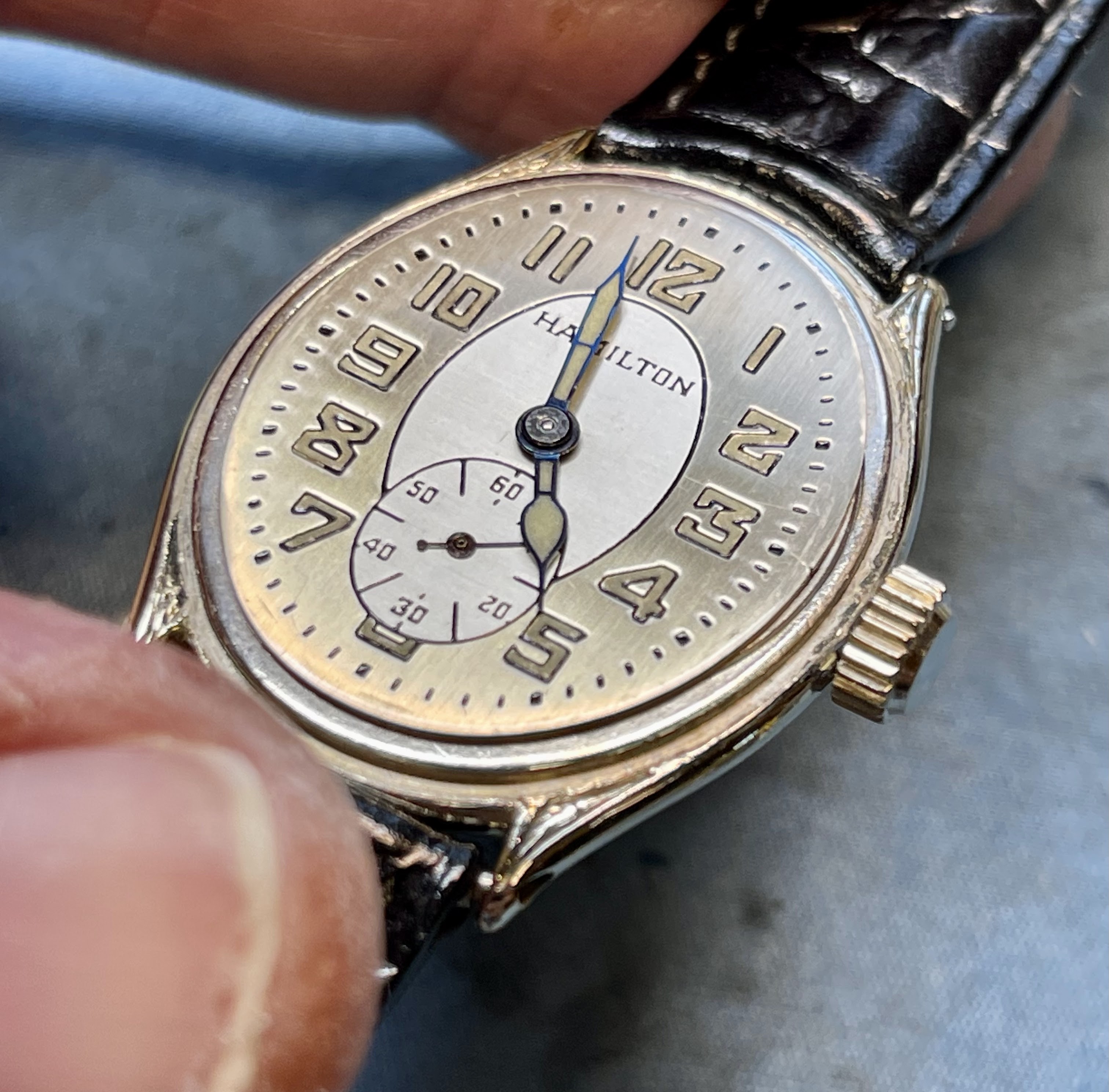
1928 Oval

Hamilton first introduced men's wrist watches a little over 100 years ago.  Their marketing department must have been comprised of engineers as they named their first models with exotic names like Cushion, Square, Rectangular and other shapes.  That lasted for about ten years and you could pretty much name the models on two hands.

One of the models that was advertised but not shown in the catalogs was the Oval.  You can see it in the advertisement below along with the "Square Cut Corner".


The Oval came in solid green and white gold as well as in gold filled.  About 400 where made in solid white gold and 200, or so, in solid green gold.  Like the other shaped models, there are versions with engraved bezels and plain.

1,876 Plain Ovals were made in white gold filled and about the same were made with Engraved bezels.  Half as many (791 / 797) were made in green gold filled.

My project watch is a very nice restored example.  The only thing that I don't like about it is the military-style crown.  It would look great on a military Keystone case from WWII but not so much on this watch.  Of course, opinions are like belly buttons - everyone has one.  So what do you think of the crown?


I've been getting more and more reticent with Hamilton's early movements.  They were extremely well-made but they are extremely unforgiving.  Plus, they tend to have the most mileage and could have years of neglected use.

I normally don't test a project watch as I assume it will run better after a service.  I did wind this one a little though and put it on the timer.  It appears to run slow and has a large beat error.  I didn't wind it fully so that could be a factor, but at least it appears to work.


The case back has been brushed.  Sometimes this is a way to hide or remove an engraving.  Other times its simply a way to make a case look clean and well maintained.  You can see the case back has had a repair of some sort.  


The lugs on the Oval are long but not long enough to use straight spring bars.  So it's not unusual for the lugs to wear out and it looks like these lugs have had some work done at some point over the years but it was done well and looks good.

The movement is loose in the case.  It's held inside the three piece case by the stem and two case screws.


One of the case screws is loose - so loose that it's almost backed all the way out.


With the bezel lifted out of the way you can see the dial and hands have been refinished.  This is an engraved dial with a two-tone brushed finish so it reflects the light differently in the center section vs the hour track.  The engraving allows a perfect refinish.

One little bit of trivia about movements from this time is the screw for the balance cock is slightly different than the screws for the other bridges.  You can see the balance cock screw at the top of the arrangement.


The mainspring inside the barrel is an old blue steel design.  I'm 99% confident it will be "set" or maintain a tight coil once it's removed.


Yup - called it.  This spring would power the watch but for no longer than 24 hours - if that much. 


When it comes to replacement, there are a few options.  I use Dynavar mainsprings whenever I can, otherwise I use modern white alloy replacements.  Springs can come in different strengths so I try to stick to the middle.  I'll go with the 90 strength on this watch.


Here's a comparison of new vs old.  A new mainspring will start to coil in the opposite direction, almost like an S.  This will power the watch for 35 hour or more.


Everything is cleaned and ready to be reassembled.


The movement is reassembled and ready to go to the timer.


Well, it's keeping good time but the beat error is well beyond my upper spec of 3.0ms.  Ugh... do I risk it and try to lower the beat error?  In order to adjust it I need to remove the balance from the balance cock rotate the hairspring collect, and then reassemble it.  Any of those actions can screw up the hairspring.


Somewhere between Bacon Hollow and Simmons Gap my cries of anguish are still echoing in the stratosphere.  Look at this hairspring!!!   As Charlie Brown would say, "AAUGH!"  I'm not exactly sure how it happened but the stud got caught on the balance cock and the balance fell out.


Someday I'll get better at tweaking hairsprings but this one is beyond my skills.  So a 1932 Webster project watch from my personal stash will need to donate it's prospects to save this Oval.  It's a worth cause.

My replacement balance runs well and the beat error is within my specs.  I'm still heartbroken that I damaged the balance but it happens with these older movements.  They are very unforgiving.


I found a better crown and I think it's a perfect replacement for this fine watch.  It look 100% better than the previous crown.  What do you think?

Thursday, December 8, 2022

1960 Thinomatic T-575

 Watches got more complicated in the 1950s, literally and figuratively.  A basic watch had two hands, an hour and a minute hand and this first complication is a second hand.  From there you can add a lot of complications like an alarm, a chime, a calendar, a day of the week, a selfwinding mechanism, a stopwatch, etc. etc..  

Watches with lots of complications are very common today but early in the 20th century just telling the correct time was the mark of a fine watch.

In 1953 Hamilton introduced it's first automatic and it did so by reintroducing the lllinois brand name.  In 1954 the first Hamilton-branded automatics hit the scene.  Hamilton also introduced date complications around the same time period.  

By the 1960s calendar models and automatics were staples of the Hamilton lineup.  Chronographs came later in the 1960s and by the 1970s watches could also keep track of the day of the week.

One of the first Thin-o-matic models to feature a calendar complication was the T-575.  It was only made for two years.


The T-575 came in a stainless steel case and with a two-tone textured dial.  The date window is at the 6 position.  As a member of the Thin-o-matic line, it featured a Swiss-made micro rotor movement made by Bure, a company that Hamilton would eventually purchase.

My T-575 project watch arrived in very nice condition but it had been a while since it was last serviced and that's important to do regularly as a watch that looks nice and even runs well, could have no remaining oil or lubrication inside after 3-5 years.


Looking closely at the case back I can see a lip between the lugs so this is a two piece case and the back should pop off.


The 17 jewel 668 movement looks to be in great shape.


Two small screws on the side of the main plate secure the dial and even though I loosened them the dial would not come off.  I looked closely and saw that one of the dial feet was missing so that meant some sort of adhesive was used to secure the dial. 

Sure enough, two small adhesive blocks held the dial on the main plate.  That's not unusual but  you don't see that very often either.


The adhesive is clearly attached to the movement and one of the screws that secures the date complications is covered.  So I'll have to pick the adhesive off the plate to get to the screw.


There... I'll do the same to the other adhesive block and use fresh "dial dots" when it's time for reassembly.


The calendar complication is very straightforward on this movement.  The hour wheel turns the indexing wheel and each revolution moves the indexing arm a little closer to the date wheel.  At 12 hours the indexing arm engages the date wheel and advances it.  The golf-club shaped lever centers the date wheel and a spring attached to the bridge provides the tension needed.


The J-shaped spring will fit into the slot on the bridge when it get reassembled.


Piece by piece the front of the main plate is stripped of parts.


Now for the back of the movement.  The first thing off is the balance and you can see this movement is based on Buren 1001, as evidenced by the stamp, although it's hard to see in my photo.


Great care is taken to remove and inspect each part and I take special note of what goes where so I can put it back together again.


Almost there, just a few more parts to go and the movement will be fully disassembled.


Finally it's all taken apart and my goal now is to clean everything and to put it all back together with no extra parts left over.


Everything is cleaned and dried.  It looks noticeably shinier now even though it looked good before.


The main parts of the movement are back in place and it's ticking away with a good motion.  Time to let the timer give it a listen.


No complaints here.  Now I can put the rest of it together.


It took a while but I eventually found my stash of dial dots.  These are tiny round sections of double-sided tape.  You apply one side to the mainplate and then remove the cover from the dot to expose the other sticky side.


I'll use two dots in the same positions as was used before.


The covers are off and now the clear sticky dots are ready to be pressed into the dial.  I also use the remaining dial foot screw to keep the dial in place.


Voila!  The finished project looks as great as it runs.  I replaced the crystal as well since the original crystal had a defect on the inside.  Now it's perfect.

Friday, December 2, 2022

1964 Dateline A-578

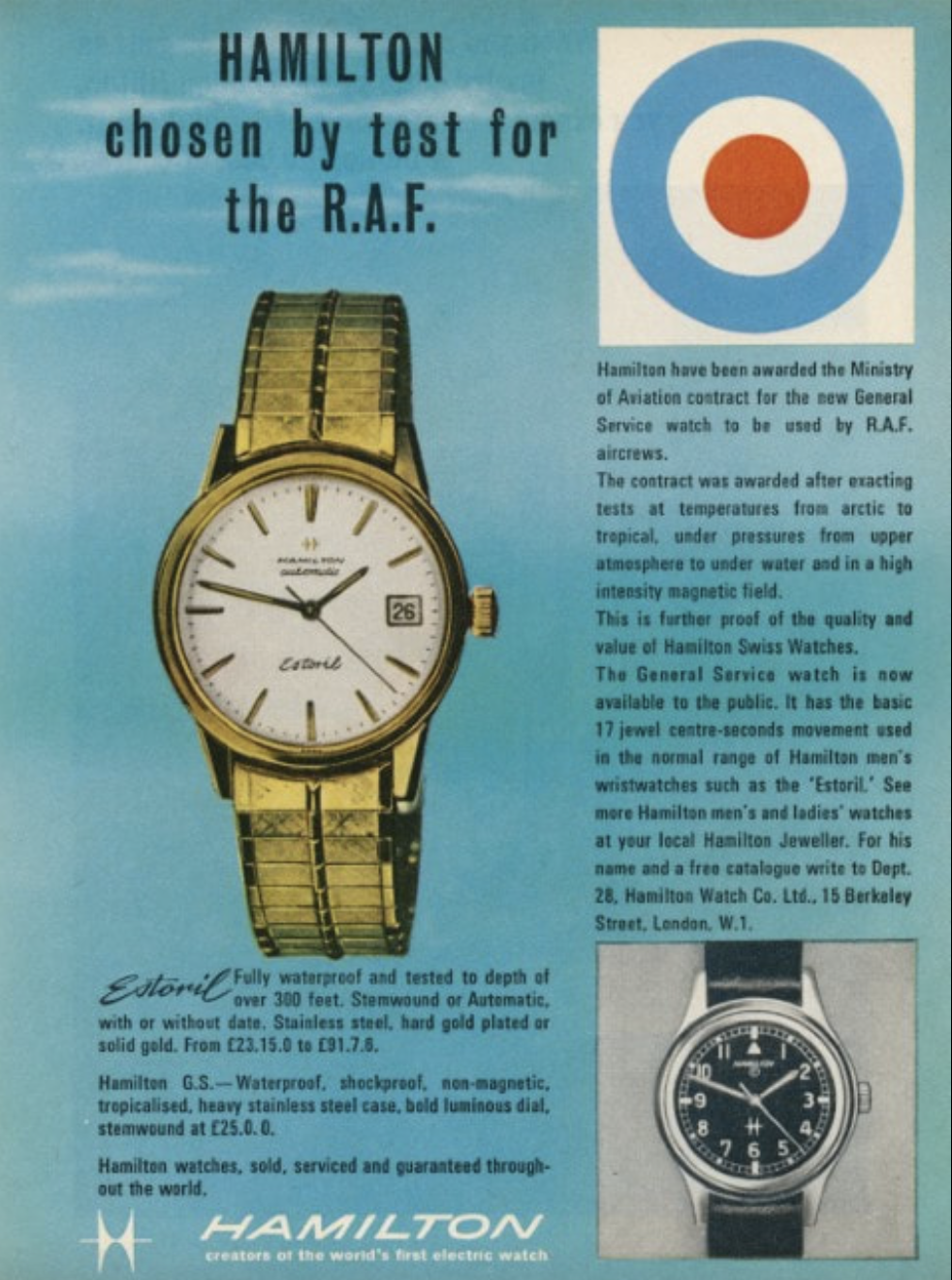
 It's not unusual to come across Hamilton watches that were intended for markets outside the US.  One clue is you can't find them in the Hamilton catalogs.  Another could be markings on the watch itself.  Some models were both, like the 1964 Dateline A-578.  It's part of the Estoril line and there are several variants that were marketed outside the US.


Estoril is a seaside region in Portugal - considered the Portuguese Riviera.  The Dateline A-578 was marketed in the US but additional versions in solid gold and gold electroplate were also offered outside the US.

The ads I found online show there are a couple of potential original bracelet designs and it's interesting to note that the font used for Estoril on the dial can vary - presumably by year or market. 


The Dateline A-578 is a dive watch, or at least intended to be capable of going to a depth of 300ft, as evidenced by the 300 on the back of the case.

The A-578 is outfitted with the 17 jewel 694A movement but sometimes you'll find Estoril models with a 64 caliber with 21 jewels.  The movements are the same other than the 64 has four additional jewels in the automatic framework.  However, if you come across a caliber 64 it's a good sign that it was marketed outside the US.

My project watch arrived in good condition and it's interesting to note the style of the hands aligns with the European advertisements but the Estoril logo is different than both the US and European ads.  So models could vary.  The bracelet is from Speidel and is not original to the watch.


The case has three parts... a back, a center and a bezel that surrounds the crystal.  Presumably it all fits together tightly, in order to be so water-tight.  After almost 60 years you should consider any vintage watch no longer waterproof - unless you are interested in costly repairs.


This model is also identified by the model number 64003-3.  The 64 represents the caliber inside (the 694A is based on the caliber 64) and the -3 represents stainless steel.  Presumably the solid gold version would be 64003-1.


Opening cases like this can be the first challenge and having appropriate tools for the job is important.  Quality counts too here, and inexpensive tools can produce disappointing results.  I use a Bergeon case opener and a Bergeon case vise to hold the case while I turn the opener.


Success!  The first step is complete and reveals a nicely preserved movement inside.  There are no signs of rust or water penetration.


Getting the movement out of the watch and the dial off is the next stop.  In this photo you can see the typical date complication that is triggered once a day, and a midnight, assuming you put the hands in the proper position.


Late afternoon sun illuminates my work bench and provides a little extra sparkle on the freshly cleaned parts.


The basic movement is completed first and it's now ticking with a good motion.  Next I'll see what the timer thinks of the beat rate.


It's running a little slow and the beat error is a little high at 2.8ms but I can easily adjust both.


There... now it's running 18 seconds fast per day with a respectable 0.3ms beat error.  A lower beat error also brought the amplitude over 200 and it will probably go up further as I continue to wind it. 


All the parts go back onto the front next, including the little spring that helps index the calendar wheel.  I have adopted the habit of putting a clear drop cloth over my head when install that spring - as it tends to disappear occasionally and the drop cloth helps narrow the search area when it vanishes.


The finished watch is back together and I paired it with a very comfortable and casual leather strap.  It now runs as good as it looks and it looks great!