In today's world you can set up your phone to tell you the time in any time zone. When you travel from one time zone to another, your technology automatically adjusts. That wasn't always the case though, and it wasn't that long ago that managing timezones was a little more cumbersome.
Watch manufactures came out with all sorts of approaches to this challenge, especially since countries as large as the US have multiple time zones and you can easily travel between them. Lots of higher-end watch companies offered a "GMT" watch of some sort. GMT stands for Greenwich Mean Time and it is the time in Greenwich, England - or timezone zero. A GMT watch typically has a hand that is set to the time in Greenwich and makes a full revolution in 24 hours. Some organizations, like the military have an official time, usually based on GMT and no matter where you are in the world the time is based on GMT. GMT watches have an interesting complication and you can buy GMT watches in today's modern Hamilton lineup.
Back in the 1950's traveling from coast-to-coast by air was becoming more possible and within the reach of the common man. You could wake up in New York and go to bed in San Francisco - all in the same day. Imagine that! If you were a pilot or a salesman, you might wake up the next day and fly back home. Who wants to set and reset their watch so often? Not me (actually it's probably not that big a deal, really).
In 1956 Hamilton introduced a several different options for folks that travelled a lot like that. The 1956 catalog showed a watch called the Transcontinental A, the Transcontinental B (in solid gold) as well as the Cross Country II.
Curiously, what's not shown in the catalogs is the 1956 Cross Country, although it's known to exist.
If you look closely at the Cross Country II add, it has an 18 jewel movement. There was only one movement with 18 jewels in the Hamilton lineup at that time, the 8/0 sized 730 movement. The case is comprised of a 10K gold filled bezel with a stainless steel back. It has a donut-shaped outer hour ring with a large rotating hour hand wheel in the center with several indices on it. It also had a moveable hour hand that you could place anywhere, most likely in your home time zone and wherever you went you just needed to read the time based on the time zone you were in... assuming it was in the continental US or England, that is. Otherwise you could read the time in Greenwich and do a little math in your head.
The Cross Country is basically the same as the Cross Country II, except it uses a 17 jewel Hamilton Illinois movement. 1956 was a big year for Hamilton and they discontinued the Illinois brand but had lots of left over Illinois movements in inventory. They used them up in "B" models and there are lots of Jason-B, Cabot-B, etc models from 1956 that had Illinois movements under the hood.
So is the Cross Country really a Cross Country II-B, or is it not II-B? That is the question... but the answer is it's just Cross Country, as you'll see below.
I recently received a Cross Country from a friend and fellow collector. As you can see, he sent it with "some assembly required". He had the outer dial refinished and asked me to overhaul the movement and put it all back together.
All of the Illinois movements are based on ETA grades as far as I know, and this one is no exception. In fact, this one says so right on the main plate (although it's upside down).
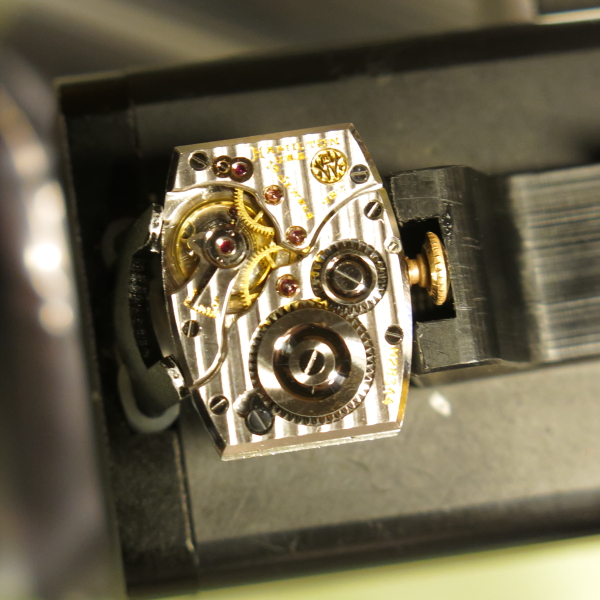
The other side of the movement shows you how tightly packed together the parts of this little 12/0 sized movement are. Illinois movements are sometimes incorrectly identified as a TXD grade, as that's what's stamped on the balance cock. In truth, TXD is the import code for Illinois and all imported Illinois movements have TXD on them, just like all imported Hamilton movements have HYL on their balance cock.
Ta-da! This is a Cross Country, no doubt about it. It's not a Cross Country IIB, which makes sense - why have a II if there isn't an I?
Piece by piece the movement is stripped clear of parts. There's a little bridge on top of the center wheel and the 4th wheel goes right though it and moves the center second hand.
Everything is cleaned, dried and laid out pretty much like what I started with.
The movement is reassembled and ticking away nicely.
It was originally running a little fast and you can see the slope of the two lines change and approach almost horizontal as the beat rate reaches 4 second fast per day.
The outer dial can now get installed using the dial feet screws. Notice the cutout to accommodate the balance's shock jewel assembly. This entire assembly can be easily changed if needed. It's held in place by a single screw.
The inner ring then drops into place like a giant hour wheel and I'll line it up at 12:00 Pacific time and put the hour hand on there since this is a California model.
The finished watch is put back together and looks fantastic. I also repainted the tip of the second hand so it stands out nicely against the dial. This is a sharp looking watch and they are highly valued. It's fun to be able work on it and not to have had to spend the big bucks to have actually bought it.
Information about vintage Hamilton watch repair, restoration, models, and advice for collecting and collectors
Welcome
Greetings!
Thursday, June 8, 2017
Sunday, June 4, 2017
1941 Rodney
Hamilton's production was dedicated to WWII military needs in the first half of the 1940's. As such, new models introduced in 1941 only had a brief period of production before the war and some of them were not continued after civilian production resumed. One of the brief one-year-wonders from 1941 was the Rodney.
The Rodney came in a solid 14K yellow gold case with a gilt dial featuring black roman numerals and bright polished pearled dots.
A coral version of the Rodney was also produced with a 14K rose gold case and a similar coral finished dial.
Both versions of the watch are relatively hard to come by. Each is outfitted with a 19 jewel 14/0 sized 982M movement under the hood. If the Rodney looks familiar to you, it may be because it looks similar to the 1948 Hayden which is much more common... or should I say the Hayden looks like the Rodney, since the Rodney came first. Of course, the Hayden is gold filled and had a cylinder crystal along with an AGN dial - so it's very different from a Rodney when you look closely.
I recently came across a Rodney for sale and I jumped at the chance to get it since unrestored versions are hard to come by. As received, it was very dirty but looked to be in decent condition. The dial is a bit grungy but I thought it might clean up okay.
Interestingly, the Rodney has male lugs and requires female spring bars. I think this may be the last model to feature this type of lug design, although there are lots of 1930's models with this feature.
This 982M movement looks fairly unremarkable and just as it should. I love the big gold medallion that these earlier movements had. Later 982Ms lost the medallion and aren't quite as impressive looking. Although the 982M is identical to the regular 982 in all major aspects, the 982M is very attractive movement with the gold lettering, medallion and bright damascening.
I'll prep a new glass crystal for installation while the rest of the parts are in the cleaner.
The mainspring in the watch is a white alloy spring but it has set and lost a lot of it's energy. I'll replace it with a fresh mainspring.
Notice how a new mainspring splays out much further and actually coils in the opposite direction. It will store a lot more energy. This watch should run in excess of 40 hours on a full wind with a fresh mainspring like this.
Everything is cleaned and dried. Reassembling a 14/0 movement like a 980, 982 or 982M can be a challenge and more than a few pallet fork and escape wheel pivots have been broken over the years during reassembly.
The reassembled movement is ticking away with good motion so it's off to the timer to listen to it's ticking.
It's running a little fast according to the timer but if you look at the photo above, you can see the regulator index is moved toward the fast end of the range.
Sliding the regulator index back toward the center adjusts the beat rate to be right in line with the desired 18,000 beats per hour.
I'll pull a fresh set of spring bars out of the vault that stores my meager stash behind 8 inches of hardened steel and is guarded by my two trained dobermans, Zeus and Apollo. These spring bars are very hard to come by.
A period correct Gemex strap completes the restoration of this all original 1941 Rodney. I was able to clean up the dial nicely and the printing loss in the upper left was actually missing when I started. This dial looks just as it should for a 76 year old watch and even though it doesn't looks perfect, it's nowhere near worthy of being refinished yet, in my opinion. I think this turned out to be a very nice example of an uncommon Hamilton model.
A coral version of the Rodney was also produced with a 14K rose gold case and a similar coral finished dial.
Both versions of the watch are relatively hard to come by. Each is outfitted with a 19 jewel 14/0 sized 982M movement under the hood. If the Rodney looks familiar to you, it may be because it looks similar to the 1948 Hayden which is much more common... or should I say the Hayden looks like the Rodney, since the Rodney came first. Of course, the Hayden is gold filled and had a cylinder crystal along with an AGN dial - so it's very different from a Rodney when you look closely.
I recently came across a Rodney for sale and I jumped at the chance to get it since unrestored versions are hard to come by. As received, it was very dirty but looked to be in decent condition. The dial is a bit grungy but I thought it might clean up okay.
Interestingly, the Rodney has male lugs and requires female spring bars. I think this may be the last model to feature this type of lug design, although there are lots of 1930's models with this feature.
This 982M movement looks fairly unremarkable and just as it should. I love the big gold medallion that these earlier movements had. Later 982Ms lost the medallion and aren't quite as impressive looking. Although the 982M is identical to the regular 982 in all major aspects, the 982M is very attractive movement with the gold lettering, medallion and bright damascening.
I'll prep a new glass crystal for installation while the rest of the parts are in the cleaner.
The mainspring in the watch is a white alloy spring but it has set and lost a lot of it's energy. I'll replace it with a fresh mainspring.
Notice how a new mainspring splays out much further and actually coils in the opposite direction. It will store a lot more energy. This watch should run in excess of 40 hours on a full wind with a fresh mainspring like this.
Everything is cleaned and dried. Reassembling a 14/0 movement like a 980, 982 or 982M can be a challenge and more than a few pallet fork and escape wheel pivots have been broken over the years during reassembly.
The reassembled movement is ticking away with good motion so it's off to the timer to listen to it's ticking.
It's running a little fast according to the timer but if you look at the photo above, you can see the regulator index is moved toward the fast end of the range.
Sliding the regulator index back toward the center adjusts the beat rate to be right in line with the desired 18,000 beats per hour.
I'll pull a fresh set of spring bars out of the vault that stores my meager stash behind 8 inches of hardened steel and is guarded by my two trained dobermans, Zeus and Apollo. These spring bars are very hard to come by.
A period correct Gemex strap completes the restoration of this all original 1941 Rodney. I was able to clean up the dial nicely and the printing loss in the upper left was actually missing when I started. This dial looks just as it should for a 76 year old watch and even though it doesn't looks perfect, it's nowhere near worthy of being refinished yet, in my opinion. I think this turned out to be a very nice example of an uncommon Hamilton model.
Saturday, June 3, 2017
1963 Lord Lancaster D
I think one of the more interesting lines of Hamilton models is the Lord Lancaster series. There are 21 men's models in the Lord Lancaster line and there are bunch of ladies models too. What makes the Lord Lancaster line unique is all of the models incorporate diamonds in their design, either on the dial or as part of the case. They typically came in white gold, gold filled or RGP but there are a few models with yellow colored cases too.
It was fairly common for jewelers to recase Hamilton movements in private label cases. That was partly because Hamilton movements could out last their original cases. But sometimes jewelers felt they could make more money recasing a movement from a Hamilton gold filled model into an aftermarket solid gold or platinum case. Often these watches were ornamented with diamonds too and you'll regularly see them for sale on eBay with ridiculous prices.
You need to make sure the case is properly marked "Hamilton Watch Co, Lancaster PA" inside the case back or you should assume it's not a legitimate, authentic model. It will usually say Hamilton on the outside of the case back too. So caveat emptor if you're in the market for a diamond encrusted Hamilton watch.
One of the Lord Lancaster models that came in a solid gold case was the 1963 Lord Lancaster D. It was made for only two years.
The Lord Lancaster D came in a 14K solid white gold case. It featured Hamilton's top of the line movement, the 22 jewel manual winding 770. The sterling silver dial featured 6 diamonds along with unique faceted markers. The strap that it came with was black suede with faille - a finely woven silk-like fabric. Priced at $175, the Lord Lancaster D retailed at almost $1,400 in todays currency. It was not an inexpensive watch and you don't see too many of them in the wild.
I recently spotted a Lord Lancaster D and snagged it when I had the chance. I wasn't sure it was a Lord Lancaster model at the time, as there are other earlier models with these same dial features like the 1956 Casino.
However, when you compare the Lord Lancaster D with the Casino there are some noteworthy differences; like the shape of the lugs and the design of the hands. In addition, the Lord Lancaster D has a "diamond edge" crystal with facets that go around the perimeter.
My watch, as received, was missing the faceted crystal which added to the model uncertainty. The lugs though are clearly correct for a Lord Lancaster D so I wasn't confused for long. Other than a little dirt, it wasn't in too bad of shape overall.
The case back was rather odd and had a yellow tone to it. I put some simichome on a Q-tip and the yellow came off. Although pure gold won't tarnish, 14K gold is only 56% pure and what it's alloyed with can tarnish and it's not usual for different alloys to tone differently. In fact, some of the earliest solid while gold models came in 3-piece cases and the individual case parts often toned differently. But a little polish brings them all back to bright white.
The scratches on the case back make me wonder if there was an inscription here at some point but I don't see any other evidence that there was.
There's a little slit on the side to slip my case knife into and pry the back away from the front bezel.
Although the movement looks good, the general haze on it indicates that it's been a while since it's been through a cleaning.
I only see one watchmaker's mark inside the case back. One cleaning in 54 years? Hopefully it sat in a dresser drawer for most of that time.
I love the 770 movement. It's a breeze to work on after monkeying around with microrotors and other automatic movements. They can still have their challenges, or course, but the 770 was extremely well thought out.
This model takes a special crystal and using the correct one should make a big difference in the look of the finished project.
The movement is back together and appears to be running okay. Notice how much bright and shinier it is now that it's been cleaned.
Hmm... something is making a little extra noise inside so I'll reclean the hairspring and check the pallet fork.
There... that's much better. This watch is running like a dream now. I'll leave it running a little fast while it settles back in.
A fresh genuine lizard strap completes the restoration of this very nice Lord Lancaster D example. Check out that faceted crystal! It really makes this watch sparkle.
This watch is not terribly large and could definitely be worn by a woman by today's standards. I'm very pleased with how this watch turned out. I'll have to hide it from my wife or it might go missing.
It was fairly common for jewelers to recase Hamilton movements in private label cases. That was partly because Hamilton movements could out last their original cases. But sometimes jewelers felt they could make more money recasing a movement from a Hamilton gold filled model into an aftermarket solid gold or platinum case. Often these watches were ornamented with diamonds too and you'll regularly see them for sale on eBay with ridiculous prices.
You need to make sure the case is properly marked "Hamilton Watch Co, Lancaster PA" inside the case back or you should assume it's not a legitimate, authentic model. It will usually say Hamilton on the outside of the case back too. So caveat emptor if you're in the market for a diamond encrusted Hamilton watch.
One of the Lord Lancaster models that came in a solid gold case was the 1963 Lord Lancaster D. It was made for only two years.
The Lord Lancaster D came in a 14K solid white gold case. It featured Hamilton's top of the line movement, the 22 jewel manual winding 770. The sterling silver dial featured 6 diamonds along with unique faceted markers. The strap that it came with was black suede with faille - a finely woven silk-like fabric. Priced at $175, the Lord Lancaster D retailed at almost $1,400 in todays currency. It was not an inexpensive watch and you don't see too many of them in the wild.
I recently spotted a Lord Lancaster D and snagged it when I had the chance. I wasn't sure it was a Lord Lancaster model at the time, as there are other earlier models with these same dial features like the 1956 Casino.
However, when you compare the Lord Lancaster D with the Casino there are some noteworthy differences; like the shape of the lugs and the design of the hands. In addition, the Lord Lancaster D has a "diamond edge" crystal with facets that go around the perimeter.
My watch, as received, was missing the faceted crystal which added to the model uncertainty. The lugs though are clearly correct for a Lord Lancaster D so I wasn't confused for long. Other than a little dirt, it wasn't in too bad of shape overall.
The case back was rather odd and had a yellow tone to it. I put some simichome on a Q-tip and the yellow came off. Although pure gold won't tarnish, 14K gold is only 56% pure and what it's alloyed with can tarnish and it's not usual for different alloys to tone differently. In fact, some of the earliest solid while gold models came in 3-piece cases and the individual case parts often toned differently. But a little polish brings them all back to bright white.
The scratches on the case back make me wonder if there was an inscription here at some point but I don't see any other evidence that there was.
There's a little slit on the side to slip my case knife into and pry the back away from the front bezel.
Although the movement looks good, the general haze on it indicates that it's been a while since it's been through a cleaning.
I only see one watchmaker's mark inside the case back. One cleaning in 54 years? Hopefully it sat in a dresser drawer for most of that time.
I love the 770 movement. It's a breeze to work on after monkeying around with microrotors and other automatic movements. They can still have their challenges, or course, but the 770 was extremely well thought out.
This model takes a special crystal and using the correct one should make a big difference in the look of the finished project.
The movement is back together and appears to be running okay. Notice how much bright and shinier it is now that it's been cleaned.
Hmm... something is making a little extra noise inside so I'll reclean the hairspring and check the pallet fork.
There... that's much better. This watch is running like a dream now. I'll leave it running a little fast while it settles back in.
A fresh genuine lizard strap completes the restoration of this very nice Lord Lancaster D example. Check out that faceted crystal! It really makes this watch sparkle.
This watch is not terribly large and could definitely be worn by a woman by today's standards. I'm very pleased with how this watch turned out. I'll have to hide it from my wife or it might go missing.
Subscribe to:
Posts (Atom)